Tag: Bitcoin

  • Bitcoin (BTC) data reveals hinderances for price recovery

    Bitcoin (BTC) data reveals hinderances for price recovery

    The market crash rocked and shocked the investment world. In a frenzy, last week the social volume of Bitcoin broke the record high in the 2017-18 bull run. The increasing mentions of Bitcoin on social media indicated a spike in interest which can be then translated into acceptance and adoption. However, as expected, the social volume of Bitcoin dropped to normal levels after the peak.

    The community chatter indicates a bearish bias in the market for Bitcoin – which may not be such a bad thing. Historical trends suggest that it is a highly bullish sentiment with high price levels that result in an increased consolidation period for cryptocurrencies. Thus, the price of Bitcoin and other cryptocurrencies may be expected to gradually recover over the course of the next few days.

    The social data from the sentiment analytics’ platform suggest that Bitcoin may be in undervalued conditions. A price recovery may be seen soon. In the derivatives market, the funding rate – fee paid for perpetual contracts – have hovered either neutral or negative. A negative funding rate means Bitcoin short traders are paying Bitcoin long traders – a bearish bias. The negative funding rate has also coincided with Bitcoin’s price recovery in the past.

    However, there are factors hindering the price recovery of Bitcoin as well. Bitcoin’s Daily Active Addresses (DAA) have stayed above 1 million for a while with the level becoming an unofficial threshold. Bitcoin’s Daily Active Addresses have stayed below the threshold level in the lower half of May.

    After a short-lived upward stint of Bitcoin, the movements of BTC whales have also disappeared. Since the ATH of Bitcoin, the holdings of 100-10k BTTC addresses have fallen drastically by nearly $4.14 billion. Moreover, Bitcoin moving to exchanges have also declined slightly.

  • Is the market crash the downfall of Bitcoin?

    Is the market crash the downfall of Bitcoin?

    The cryptocurrency market crashed brutally. It all started when Tesla denounced the use of Bitcoin as a mode of payment for electric cars. The CEO Elon Musk had been a strong advocate of cryptocurrencies so the sharp turn in his stance resulted in bearish divergence in the market. The crash had been further fueled by a Chinese financial committee’s report which said to launch a crackdown on cryptocurrency mining. The crypto market took another hard hit after the news as China is accountable for a good proportion of Bitcoin mining.

    However, is the crash really bad for the cryptocurrency market? The bull run had bought the cryptocurrencies and blockchain technology under the limelight. Corporate behemoths, governments, small retailers, and innovative startups have all accepted the technology because of its many use cases.

    Sentiment data from a report published by Santiment.com – a sentiment data analytics platform –reveals that the crash may not be as bad for the acceptance of cryptocurrencies worldwide. The weekly report revealed that interest in cryptocurrencies had been increasing.

    The social volume of Bitcoin had shot up drastically in the bear market. Interestingly, the social volume also exceeded the record high of the 2017 bull run. The data indicates growth in the cryptocurrency sphere. Mentions of the “bear market” had also increased drastically – which is to be expected.

    Despite the bearish outlook of the market, the general sentiment for Bitcoin had stayed positive. With the “buy the dip” mantra, investors are positive that Bitcoin and other cryptocurrencies will eventually pick back up. It is also the positive sentiment that usually leads to crashes as the market becomes overheated and fear of corrections overtake. Bitcoin did see a shift in sentiment to the negative side after the Chinese Financial Committees report.

  • Crypto futures down by as low as 43%

    Crypto futures down by as low as 43%

    The market crash had been hard, to say the least. All cryptocurrencies have stockpiled immense losses in the past couple of days.

    The perpetual futures market has been trading in par with the spot market. However, amidst high volatility – like what was witnessed today – the difference between perpetual futures and spot trading can skyrocket. Due to high liquidation orders, exchanges are sometimes unable to meet the liquidity requirements or create most positions which leads to a high gap between the price level at which perpetuals are traded and the sport traded price.

    Ethereum, Litecoin, and Sushi went as low as 43% in the futures market from their spot traded price. Ethereum futures were operating at 26% below while Sushi perpetual futures traded for 43% below the spot traded price. Although the wide gap was harmless. Automatic stop orders were not triggered even as the perpetual futures were trading way below the spot price. The gaps were also not long-lasting and the market quickly corrected.

    However, recent price action shows that the bearish trend of the market may have been reversed. Bitcoin breaks above the price level of $40,000 which was acting as a strong resistance level for the cryptocurrency. The previous support of $46,000 will now be acting as strong resistance for the coin.

    After falling to a five-month low of $30,000, the cryptocurrency has finally picked up bullish momentum with the price standing at $41,911 at the time of writing. Following the king of the market, other cryptocurrencies have also started off an upside move. In the 24-hour timeframe, BTC went up by 16% while ETH increased by 19%.

  • Institutions dumping Bitcoin for gold reveals JPMorgan

    Institutions dumping Bitcoin for gold reveals JPMorgan

    After Elon Musk announced Tesla will no longer be accepting Bitcoin (BTC) as a mode of payment, the cryptocurrency market had been tumbling downwards. Bitcoin touched a low of $30,000 – losing nearly half of its value from its April all-time high of $65,000.  The crash has caused panic in the market with investors looking to dump their BTC holdings.

    The merits of Bitcoin over gold have been long debated. The king of cryptocurrencies has been oftentimes compared to gold. As the value of digital gold skyrocketed during the bull run of 2021, institutional behemoths turned towards Bitcoin rather than gold. Bitcoin offers a much higher return on investment and the bull run further propelled the returns.

    However, such heavy losses cannot be ignored. JPMorgan’s analysts revealed in a note to investors that institutional investors are going back to gold and abandoning cryptocurrencies like Bitcoin. The news may not come as a surprise to many as the sentimental analysis of the market reveals strong fear. The fear and greed index places the market at a score of 11 – with zero as the highest level of fear.

    The investment bank also revealed that the Bitcoin futures saw the first biggest decline since the beginning of the bull run. The BTC market continues to suffer with institutional investors withdrawing heavily every day.

    Despite the bearish outlook of the market, JPMorgan Chase still maintains its long-term bullish projection for the cryptocurrency. The banking giant predicts that Bitcoin will eventually reach towards $146,000 in the long-term window.

    At the time of writing, Bitcoin stands at a price level of $40,310. The price has increased in the past twenty-four hours. The daily trading volume of the cryptocurrency is also moving upwards.

  • Bitcoin (BTC) losing its touch – market sentiment analysis

    Bitcoin (BTC) losing its touch – market sentiment analysis

    Bitcoin (BTC) crashed to a low of $30,681. The market dip has resulted in immense losses for the king of cryptocurrencies. At the time of writing, BTC was trading hands at $39,724. Bitcoin has since recovered somewhat from the low of $30k; however, in the daily timeframe, the price is still falling while the market sentiment for the coin remains bearish.

    Bitcoin (BTC) Sentiment Analysis

    The cryptocurrency market is highly speculative and moves a lot with emotions. A market dip and some unsavory words can cause investors and traders to panic. The fear and greed index measures the overall emotion of the market by incorporating market volatility, dominance, social media sentiment trends, and market volume.

    Bitcoin (BTC) Historical Values
    Bitcoin (BTC) Historical Values

    Currently, the fear and greed stand at a value of 11 which means there is extreme fear in the market. The lower value also represents buying opportunities.

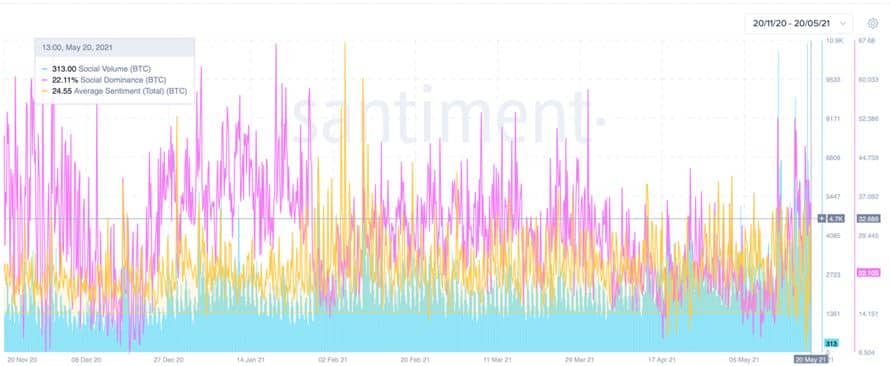
    The sentiment analysis of Bitcoin shows that the average sentiment (net of positive and negative sentiments) has moved from a negative figure to a positive today. Bitcoin continues to be one of the top trending keywords.

    Sentiment Analysis
    Sentiment Analysis

    The Social Volume of BTC crypto – the number of mentions on social media – is declining for the cryptocurrency. The Social Dominance – the mentions of BTC relative to other major cryptocurrencies – is also on a downward trend at only 22%. The king of cryptocurrency had also lost its dominance in the market with it being down to as low as 40% – a record low since the 2018 crash.

    Experts’ battle on Bitcoin (BTC)

    Peter Schiff – economist and global strategist at Europac.com – had taken to his Twitter account to bash MicroStrategy CEO Michael Saylor’s advice on firms adding Bitcoin to their balance sheets. Schiff stated that firms’ annual expected inflation rate of 2% is now down by 34% in one month. However, Schiff faced a lash back from a good number of his nearly 500k followers.

    MicroStrategy CEO Michael Saylor also ensued in a Twitter debate with Schiff regarding BTC and its return on investment. MicroStrategy remains undeterred in their decision to add Bitcoin to their balance sheet. The firm purchased an additional Bitcoin worth $10 million in the current dip.

  • BTC losing its luster – $100 million offloaded

    BTC losing its luster – $100 million offloaded

    Elon Musk – the Tesla CEO – has hinted towards abandoning Bitcoin as a mode of payment for his Tesla cars. The CEO has turned against the king of the market because of the environmental costs it is said to have. The billionaire CEO has been an ardent supporter of Bitcoin and other cryptocurrencies and because of the huge following he has; he also holds immense power over the market.

    Elon Musk has caused a market crash that is considered to be the beginning of the dreaded market corrections that are considered to be looming close. The crypto market crashed nearly 10% following the tweets of Elon Musk. The market appears to be gaining back some momentum but Bitcoin has taken a hard hit.

    Bitcoin (BTC) considered the king of the market has lost 10% of its dominance. Bitcoin dropped to a record low dominance of 40% since the 2018 market crash. Some altcoins are thriving regardless of the brutal market corrections going on –indicating a shift in trend from Bitcoin to newer cryptocurrencies.

    CoinShare’s weekly Digital Asset Flow report shows a staggering drop in Bitcoin Investment. Institutional investors have offloaded $100 million from Bitcoin exposure. The outflow of $100 million is considered the largest in the history of the report.

    The $100 million exiting Bitcoin investment products equal 0.2% of assets under management which may not seem as much but given the market sentiment, it could warrant even more losses in the market.

    The digital asset flow report also found a shift towards altcoins. Excluding Bitcoin, cryptocurrencies saw an inflow of $48 million in investment. Ethereum accounted for 50% of the inflows while Cardano and Polkadot also saw increased inflows. The data is indicative of investors looking to diversify their portfolios and move away from Bitcoin.

  • Elon Musk’s cryptocurrency market crash

    Elon Musk’s cryptocurrency market crash

    The cryptocurrency market has crashed around 10% all thanks to Elon Musk’s tweet saying “Indeed”. The Tesla CEO hold immense power over the cryptocurrency market since the whole market is purely speculative. Musk’s tweet was a response to a threat stating Tesla may dump its Bitcoin holdings because of BTC’s high energy consumption and the subsequent harm to the environment.

    The hint towards Tesla dumping its BTC holdings has spiraled into a hard market crash. Bitcoin has fallen to nearly $45,000 with its market dominance crashing to 40%. The fall in BTC’s dominance is huge and has caused a further panic in the market. The dominance is currently at its lowest since the market crash of 2018 – hinting towards a similar cooling of the market.

    Bitcoin is currently down by 35% from its all-time high established in April. Ethereum, the queen of the market, has suffered to. ETH is down by 24% from its all-time high established earlier in May. The rest of the market is following suit with cryptocurrencies showing nearly double-figure losses in the weekly timeframe.

    Elon Musk has also been called a hypocrite for ditching Bitcoin because of its high energy consumption. Galaxy Digital, a cryptocurrency firm, has released a report titled “On Bitcoin’s Energy Consumption: A Quantitative Approach to a Subjective Question”. According to the estimates of the study, the energy consumption of Bitcoin stands at $113 TWh inclusive of miner demand, pool power, node power, and miner power consumption. The figure is two times less than the energy consumption of the banking sector as well as the gold industry.


    Bitcoin has been bashed for not being environmentally friendly and with Elon Musk being the latest to join the ranks of those, the study has shed light over the important issue.

  • UK Banks Not Fans of Cryptocurrencies

    UK Banks Not Fans of Cryptocurrencies

    Where on one hand the cryptocurrency market is soaring and institutions are realizing the potential that the blockchain technology holds, on the other hand there has also been an increase in the growing skepticism.

    The cryptocurrency adoption has seen some major developments. From major financial institutions like Goldman Sachs providing cryptocurrency exposure to clients to corporate behemoths like Tesla accepting cryptocurrency payments, the cryptocurrency industry has come a long way. But amidst all that, it cannot be ignored that cryptocurrencies have a notorious reputation for being the hotbed for illegal activities.

    A major UK bank, NatWest, has issued a statement stating the bank will refuse service to customer who deal in cryptocurrencies. Morten Friis, head of the bank’s risk committee, revealed in a recent shareholder meeting the bank has no interest in dealing with clients whose businesses are backed by cryptocurrency exchanges or cryptocurrency trading and investing is their primary activity.

    The bank’s decision stems from the notorious reputation of cryptocurrencies as well as crypto regulation. The regulation of the cryptocurrency is also a sore topic for many and entails unnecessary complications for anyone looking to get involved in the crypto sphere.

    This is not the first time UK banks have had such a strong stance on cryptocurrencies. Another UK bank HSBC also has a strong anti-crypto narrative. The bank has barred its users from investing in MicroStrategy – the business intelligence company with major cryptocurrency investments. HSBC had also denied users to deposit profits from cryptocurrency exchanges.

    The UK banks anti-crypto stance will also have consequences for the cryptocurrency adoption as corporate clients like Tesla that are moving towards accepting cryptocurrency payments will also now face difficulties.

  • Is It Time For Bitcoin To Move To Proof-of-Stake Mechanism?

    Is It Time For Bitcoin To Move To Proof-of-Stake Mechanism?

    Ripple co-founder Chris Larsen certainly thinks so. In a blogpost, Larsen detailed about the shortcomings of the proof of work mechanism. Bitcoin is the market leader but the high transaction costs as well as the energy costs may prove to be a hindrance in its way of maintaining its rank which is why the co-founder suggests it is high time Bitcoin shift from a proof of work mechanism to a proof of stake mechanism.

    Larsen furthered that newer cryptocurrencies are moving away from the energy-intensive proof of work mechanism as well as older cryptocurrencies. Ethereum, the queen of the market, in its much-anticipated eth2.0 upgrade has also designed a move from proof of work to proof of stake. Per the co-founder, altcoins utilizing proof of stake mechanism now comprise 43% of the market – including Ethereum. But where miners and other stakeholders are vowing to utilize green sources of energy, there needs to be renewed efforts to move the crypto industry towards sustainable energy or sustainable mechanisms.

    Ripple Labs has not been a fan of Bitcoin because of its increasing carbon footprint. Brad Garlinghouse, CEO of Ripple Labs, have also been actively speaking out against the environmental costs of cryptocurrency mining – especially Bitcoin since it is done at such a massive scale. Garlinghouse had stated that one transaction on the Bitcoin block chain is equal to the environmental impact of 75 gallons of gasoline burned.

    As the cryptocurrency industry moves towards mass-scale adoption, the environmental impact of mining cannot be ignored. With the proof of work mechanism more energy intensive than the proof of stake, a shift to the more efficient technology will become imminent.

  • Bitcoin (BTC) Technical Analysis: 22 April

    Bitcoin (BTC) Technical Analysis: 22 April

    The market sentiment for Bitcoin (BTC) has turned bearish ever since the cryptocurrency established its all-time high at $64,863. In the 24-hour timeframe, Bitcoin started off the day at $53,399 but the bears quickly drew the cryptocurrency to the daily low of $52,657. Bitcoin remained on an uptrend for a while and established the 24-hour high at $54,850 but fell, subsequently. At the time of writing, Bitcoin stands at $52,500.

    Bitcoin (BTC) Technical Analysis

    The technical indicators stand at a neutral position. Bitcoin had been operating in an ascending channel formation with the upper boundary of the channel acting as strong resistance. After completing an Elliot wave, the bearish divergence of the coin intensified and instead of a pullback from the lower boundary of the resistance level, Bitcoin broke out of the channel to the downside. The bearish pressure on the cryptocurrency is also indicated by the 50 Moving Average. Bitcoin has fallen below the 50 MA level – hinting protracted bearish divergence.

    The immediate resistance level lies at 1.618 Fibonacci level parallel to the price level of $55,000. The weekly closing of $60,000 is another major resistance which lies parallel to the 0.5 Fibonacci level. While strong support can be found at $50,755 – at the 2.168 Fibonacci level.

    The future predictions for the cryptocurrency are not optimistic as the market for Bitcoin is in the grips of bears. The cryptocurrency may settle near the support level or if a trend reversal is spotted then the first major resistance level will be a viable price target.

    Bitcoin transaction fee has hit a new record high at $59.87 according to BitInfoCharts. The transaction fee has surpassed the high of the 2017 bull run as well which stood at $55.17. While the high transaction fee suggests an increasing traffic on the block chain, it can also result in a subsequent decrease in the number of transactions on the block chain which appears to be waning.