Tag: Blockchain

  • Internet Computer: The next step in blockchain innovation?

    Internet Computer: The next step in blockchain innovation?

    The Internet Computer (ICP) made its debut on Monday but the initial success of the cryptocurrency left the market in shock. In just a few days, Internet Computer landed itself a spot in the top ten cryptocurrencies in terms of market capitalization – with ICP at even the fourth rank at one point. ICP gave a run to established coins like Litecoin and Ripple for their money. At the time of writing, Internet Computer stands at eight rank in the market with a price level of $308.

    Internet Computer’s price level had a stark difference on different exchanges. On its Coinbase debut, ICP was priced at $630 but surged as high as 3,093 on Binance. HitBTC reported an all-time high at $407. Even with such high differences, the cryptocurrency has managed a phenomenal growth of its capitalization which landed it in the top ten list.

    The internet Computer is described as a computing project based on the blockchain. The project has been regarded as the next step in the evolution of blockchain technology following Bitcoin and Ethereum. The price rally of the cryptocurrency just after days of its launch further fueled the narrative of it being the next phase of Blockchain evolution.

    Dfinity, the organization behind ICP, hopes to become the first-ever truly global blockchain that runs with unlimited scalability and unmatched web speed. ICP is designed to host online services through the internet instead of requiring cloud hosting.

    However, the rise of ICP to the top ten cryptocurrencies may have resulted due to a carefully-crafted strategy of Dfinity to land it there. The ICP was listed by major cryptocurrency exchanges almost simultaneously which exposed it to a large user base all at once. Furthermore, the project also has the backing of some high-profile players. The United States angel investor Andreessen Horowitz and a cryptocurrency hedge fund, Polychain Capital, are some of the prominent ones.
  • How many Americans actually own cryptocurrencies?

    How many Americans actually own cryptocurrencies?

    A survey conducted by New York Digital Investment Group (NYDIG) on cryptocurrency usage has been making rounds on the internet. The survey reveals that 46 million Americans or 17% of the total population now own at least a share of Bitcoin. A majority of the respondents also showed interest in learning more about Bitcoin and to integrate the cryptocurrency in their personal financial plans including life insurance.

    The survey by NYDIG furthered that 53% of respondents said they do not own cryptocurrencies but out of those, 55% said they would consider adding cryptocurrencies into their profiles.

    The news of the survey first started circulating after being published by Newsweek and it spread like wildfire. Major Bitcoiners like MicroStrategy CEO Michael Saylor retweeted the post. Kraken and Coin Metrics, too, were celebrating the 46 million figure – citing cryptocurrency adoption is nearby.

    The 46 million figure is impressive and is a testament to the fast-paced adoption of cryptocurrencies and the blockchain technology. It is, in fact, a feat to be celebrated. However, how accurate exactly is this figure? Where the figure of 46 million is being celebrated, on the other hand people are also calling out the accuracy of the figure.

    The $46 million figure is from a survey conducted in January by NYDIG which was referred to in a recent survey by NYDIG. The sample size, although valid, was small of both the surveys. The first survey had 1,050 participants with income above $50,000 while the second had 2,184. The discrepancy may have emerged from the sample size.

    The survey of NYDIG may not paint an accurate picture. Another survey conducted by Gemini – the crypto exchange – with a sample size of 3,000 placed the figure of people who own cryptocurrencies at 21.2 million of 14%.

  • The importance of Ethereum’s DeFi technology: Federal Reserve Bank’s paper

    The importance of Ethereum’s DeFi technology: Federal Reserve Bank’s paper

    Federal Reserve Bank of St Louis has issued a paper which details into the role of Ethereum and decentralized finance in the financial ecosystem of the world. The research panel was headed by Dr. Fabian Schar – professor for Distributed Ledger Technologies and FinTech at the University of Basel.

    The queen of cryptocurrencies may have revolutionized the financial ecosystem with its DeFi technology. The decentralized finance sphere has been surging with the total value locked at a staggering $134 billion. DeFi is considered as the future especially with new innovations happening in the sphere.

    According to Dr. Schar, if the current security and regulatory problems with decentralized finance are resolved then it may result in a paradigm shift in the financial industry. praising the accessibility, operability, and efficiency of the system dr. Schar wrote about how smart contracts fuel the decentralized finance by replicating existing financial services.

    Ethereum steps in into the picture as it is looked up at as the pioneer of the DeFi sphere. The backbone of the decentralized finance, smart contracts, majorly run on the Ethereum blockchain. Moreover, most of the popular DeFi projects like Maker (MKR) also run on the blockchain of Ethereum. Hence, Ethereum with its blockchain is powering the DeFi sphere which gives it a very important role.

    Ethereum has shown phenomenal performance in the bull run – leaving the king of the market behind. ETH coin surged upwards establishing a new all-time high at $3,523. At the time of writing, the cryptocurrency stands at a price level of $3,380. The on-site metrics show that Ethereum is still surging upwards and higher highs may be established soon. The market sentiment for the coin is strongly bullish.

  • Mastercard survey reveals growing appetite for digital payments

    Mastercard survey reveals growing appetite for digital payments

    A survey conducted by Mastercard revealed that four in ten people are open to using cryptocurrency payments in the next year. The credit card giant surveyed around 15,500 people from 18 different countries in the survey titled “Consumer Appetite for Digital Payments Takes Off”. The 40% people that intend to use cryptocurrencies spanned across all age groups.

    The poll further revealed that millennials – people aged between 18 and 39 – are more interested in cryptocurrencies. 67% of the millennials in the poll agreed that they are more open to cryptocurrency use than last year while a whopping 77% of the respondents were keen on learning about cryptocurrencies. Moreover, 75% agreed that they would incorporate digital assets into their lives if they understood them better.

    The consumer appetite for digital payments is really taking off. The new year saw a bull run that matched the highs of 2018. A major difference in the current bull run and that of 2018 was the acceptance that cryptocurrencies received. Where in 2018, the majority was skeptical of cryptocurrencies with little or no news cryptocurrency adoption, the situation is completely different this year. A lot of people have accepted cryptocurrencies as the future. The relevance of the blockchain technology has been accepted by everyone – from small-scale investors to corporate behemoths.

    The credit card giant has been vocal about its support for cryptocurrencies. In February, Mastercard had announced that it will incorporate digital payments for its one billion users at more than 30 million merchants. Mastercard has also launched an accelerator program for fintech startups which also included many crypto and blockchain-based firms. The credit card giant has also been vocal about the need for allowing all payment methods as the world moves towards digitization.

  • Dollars pouring in to the crypto sphere

    Dollars pouring in to the crypto sphere

    Paxos, a regulated blockchain infrastructure with aims to create an open financial ecosystem, has raised $300 million in a funding round. Paxos also powers the cryptocurrency services of PayPal and PayPal-owned Venmo. PayPal and Venmo, together, enables millions of users to trade cryptocurrencies – all through Paxos.

    The series D funding brought the valuation of the company to a whopping $2.4 billion. The round was funded by Mithril Capital, Senator Investment Group, Declaration Partners, PayPal Ventures, Liberty City Ventures among others.

    CEO of Paxos Charles Cascarilla had commented that the demand for the company’s services and products has skyrocketed. The funds raised will be used to invest in the development of blockchain and cryptocurrency infrastructure to fulfill the company’s mission of a new and open financial ecosystem. Paxos has ambitious plans of achieving its goals and it is heading straight in that direction. Paxos recently got preliminary approval for the creation of a national trust bank.

     In another corner of the world, German securities marketplace Deutsche Boerse and the major bank Commerzbank have announced an investment worth of $12 million into a new crypto venture, 360X for the development of a marketplace for NFTs. The German securities marketplace and Commerzbank have a history of partnering together for cryptocurrency-related projects. Deutsche Boerse revealed the marketplace has invested $12 million with a stake of 50% while Commerzbank owns a lesser stake in 360X.

    The announcement of Deutsche Boerse marks the official launch of 360X. 360X is set to focus on art and real estate initially. The network will also support the trade of non-fungible tokens. The model of 260X is said to be highly scalable and, hence, the project will expand to various other asset classes in the future.

  • Two Crypto Firms Make it to TIME’s Most Influential Companies’ List

    Two Crypto Firms Make it to TIME’s Most Influential Companies’ List

    The cryptocurrency market has observed performance unparalleled to other investment alternatives. The bull run of 2021 resulted in a renewed fame of cryptocurrencies as well as a wider acceptance. Where the views of sceptics would turn the market bearish once, today institutional behemoths, billionaires, and veteran investors have all pledged their support to cryptocurrencies.

    The influence that blockchain technology has on our lives is inadvertently going to rise as we become more entangled with the technology. Two cryptocurrency firms have made it to TIME magazine’ 100 most influential companies’ list. The crypto firms to have made I to the list are Coinbase and Digital Currency Group.

    The Top 100 Most Influential Companies’ list had four broad categories – Pioneers, Leaders, Innovators & Disrupters. The list gauged the impact that firms have been able to create over the course of a year.

    Coinbase, the leading cryptocurrency exchange, recently got listed on NASDAQ which marked a turning point in the journey of cryptocurrency adoption & acceptance. Coinbase had recorded revenues higher in the first quarter of 2021 than the previous full year. The crypto exchange was listed alongside giants like Facebook and Alibaba and the magazine called it be “shoring up cryptos credibility” specifically pointing towards the direct listing on April 14.

    Digital Currency Group made it to the list primarily because of its subsidiaries, Grayscale & the crypto news website CoinDesk. Grayscale is an asset management firm dealing in cryptocurrencies. Grayscale’s assets under management totals to $45.4 billion. Digital Currency Group’s name on the list may also be attributed to the recent partnership between DCG and TIME magazine for a series of educational videos on cryptocurrencies, for which TIME will be paid by Grayscale in cryptocurrencies.

  • A New Leap in the Crypto Industry: ASEAN Blockchain Consortium

    A New Leap in the Crypto Industry: ASEAN Blockchain Consortium

    Blockchain organisations from Australia, Singapore, Malaysia, Thailand, Indonesia and the Philippines have decided to enter into a partnership in order to promote blockchain technology. The Blockchain Association Singapore (BAS) has initiated a memorandum of understanding between the organizations. The MoU has resulted in the formation of a new blockchain consortium dubbed as ASEAN Blockchain Consortium.

    The ASEAN Blockchain Consortium comprise of Blockchain Australia, Phillipines’ Distributed Ledger Technology, Labuan International Business and Financial Centre of Malaysia, AsosiasiBlockchain Indonesia, and Thailand Digital Asset Operators Trade Association. This initiative if the first of its kind – taken to promote blockchain technology.

    The new blockchain consortium not only plans to educate on blockchain technology and promote it but also help cooperate with regulators to ensure legal compliance in the industry. The consortium was much needed by the cryptocurrency industry as regulators throughout the world are struggling with cryptocurrencies and a huge part of the struggle is blockchain education – or lack thereof. Being a relatively new technology, not many are well-versed in blockchain and cryptocurrencies which leads to unnecessary complications especially with even novel innovations like non-fungible tokens.

    The crypto industry has grown phenomenally in the past few months. From big institutions to small scale traders, everyone has realized the value the technology holds and mass adoption of cryptocurrencies and block chain technology appears to be imminent now. Southeast Asia and Australia has seen some of the highest numbers of cryptocurrency adoption recently which makes the ASEAN Blockchain Consortium the right step taken at the right time. The Consortium also makes a new leap in the adoption of the cryptocurrency industry.

  • Rampant Increase In Crypto Scams – Is ASIC’s stance too weak?

    Rampant Increase In Crypto Scams – Is ASIC’s stance too weak?

    Australian Securities and Investment Commission (ASIC) has been vocal about promoting and supporting the cryptocurrency industry in the country but regulating the crypto sphere is a tricky business and along with most governments throughout the world, the Australians are struggling too.

    Previously, at the Australian Blockchain Conference, senior advisor of strategic intelligence at ASIC – Jonathan Hatch –appealed for collaboration from the crypto industry. Hatch also pointed out towards some of the efforts of ASIC to build trust and harbor innovation in the country. However, Hatch did not receive positive feedback from the crypto industry as most crypto firms regarded ASIC’s cryptocurrency regulation as vague and unclear.

    ASIC commissioner Cathie Armour – speaking today during the Australian Blockchain Conference – furthered the stance of ASIC on the crypto industry. Armour stated that ASIC is working towards improving the financial ecosystem in the country all the while ensuring that stakeholders have confidence in the system. The commissioner was also keen on the idea of incorporating various blockchain products in order to achieve ASIC’s goal. Armour specifically mentioned the distributed ledger technology (DLT) and its potential. ASIC is planning to integrate DLT into its clearing system.

    However, a much as the Australian regulator is keen on supporting the crypto industry strict regulation is also crucial in order to protect consumers. There has been a rampant increase in the number of crypto scams reported. Dating sites and apps have become a hotbed for crypto-asset scams. While last year, during the pandemic the regulator recorded a 20% increase in scam activity. It is now high time the regulator needs to evaluate the existing crypto regulation and whether or not they are doing enough to ensure safety.

  • Blockchain Powering Metal Refinery in Dubai

    Blockchain Powering Metal Refinery in Dubai

    UAE has been one of the front liners in cryptocurrency and blockchain adoption. The government values the potential of blockchain technology and has been an active supporter of it. Dubai Multi Commodities Centre (DMCC), a free trade zone established by the government, entered into a partnership with REIT Development to construct a precious metal refinery

    The sale and purchase agreement of a 100,000 square foot land has been announced to have been signed by the parties. This will be the largest precious metal refinery and storage unit in the Gulf region. Moreover, the refinery will be backed by blockchain technology.

    The facility will have precious metals like gold, silver, platinum, palladium etc. and these precious metals will provide backing for asset-collateralized stablecoins. The stablecoins like GoldCoin, SilverCoin etc. will be based on the Ethereum network and each coin will be backed by one gram of the respective metal. The precious metal-backed stablecoin will be traded on DMCC’s gold exchange platform.

    The blockchain-based metal refinery is just one use of blockchain technology. The refinery is also a testament to the fast pace at which blockchain is being integrated. The day may not be too far when cryptocurrencies become the mode of payment as well as a viable investment tool.

    UAE minister of economy Abdulla Bin Touq Al Marri, in the World Economic Forum’s conference on Global Technology Governance, had stated that the integration of blockchain technology into the country is the way to double the economy of UAE in a decade’s time. UAE also has a few more ambitious projects under works that are focused on the incorporation of block chain technology as well as supporting innovation in the crypto sphere.

  • Uniswap – One Step Closer to V3

    Uniswap – One Step Closer to V3

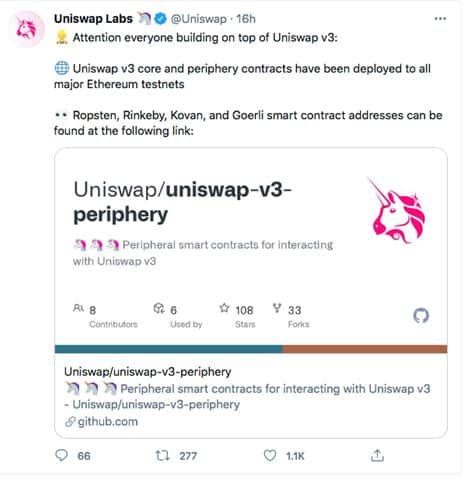
    The leading decentralized exchange, Uniswap, has moved a step closer to its third iteration as it has announced the successful deployment of V3 smart contracts to Ethereum’stestnets. The smart contracts are now on Ethereum’stestnets – Ropsten, Rinkeby, Kovan, Goerli – and the testnet addresses have been posted on GitHub. Amidst the developments of Uniswap V3, the DEX has also reported a record high weekly trading volume of $10 billion.

    Uniswap V3 is the newest iteration of the Uniswap protocol. The iteration is designed to provide better capital efficiency for users and greater capital control for lenders. This will be done through the two hallmark features of the iteration – concentrated liquidity and multiple fee tiers. The result will be the most efficient and flexible AMM ever made, according to Uniswap’s team.

    Uniswap has a high valuation and dominance in the Automated Market Maker sphere but the new iteration will further boost the DEX. Previously, the announcement of the V3 had led to a surge in the price of the native token of the governance. The launch of the V3 iteration will probably result in another price surge of the native token, UNI.

    The iteration is set to launch on May 5.