Tag: News

  • South Korea and the 22,000 NFTs

    South Korea and the 22,000 NFTs

    The official political race in South Korea is planned for March 9, 2022. Yoon Suk-yeol, an official competitor, made non-fungible tokens (NFTs) with his own pictures and recordings on Monday (March 7).

    The support of NFTs by official applicants should have been visible as a stratagem to prevail upon a portion of the more youthful electors, especially those in their 20s and 30s. Many accept this age gathering to be the most dynamic in the crypto and NFT industry.

    Yoon has likewise made 4,000 NFTs on the Aergo blockchain, which is currently accessible for buy on the South Korean NFT commercial center CCCV for 50,000 Korean won ($40.78). He does, be that as it may, mean to give an aggregate of 22,329 NFTs.

    Essentially, official up-and-comer Lee Jae-Myung of the Democratic Party of Korea (DPK) delivered NFTs of his picture to create gifts.

    In the interim, as indicated by Gallup Korea’s latest official political race survey, Yoon Suk-yeol is ruling the official race with a 39 percent endorsement rating. DPK official up-and-comer Lee Jae-myung, then again, is a nearby second with 38%.

    Both official competitors Yoon and Lee have promised to help with crypto-accommodating arrangements. One of these promises is to lift a metropolitan restriction on introductory coin contributions (ICOs) that has been set up beginning around 2017.

    South Korea’s administration has been attempting to carry out serious principles on the nation’s crypto and computerized resource environment starting around 2021.

    One more guideline suggested a 20% expense on bitcoin merchants who made more than $42,000 in benefit. The decision Democratic Party, then again, has suggested postponing the execution of the guidelines, referring to an absence of a thoroughly examined arrangement to carry out the burdening strategy.

  • Japan set to revise Crypto Laws in the Country

    Japan set to revise Crypto Laws in the Country

    In Japan, where the country’s top financial and crypto regulator has proposed legal revisions to payments-related legislation, a slew of new crypto regulations are on the way.

    The ideas came from the Financial Services Agency (FSA), which recommended amending two current acts of law in order to “create a robust and efficient settlements system” for the digital financial era.

    Stablecoin-related issues are included in the legislation, as well as new protocols aimed to “enhance the effectiveness of [crypto] transaction monitoring at banks” and other financial institutions, according to CoinPost.

    The FSA stated that certain stablecoins and stablecoin issuances do not provide enough user protection, despite the fact that complete measures for the regulation of these assets are expected to be released later.

    Brokers, like crypto exchanges, will be required to report to regulators on a regular basis. It will also have the authority to issue document submission requests, perform on-site inspections, issue business improvement orders, and even close down enterprises that do not comply or satisfy criteria.

    The bundle of measures, on the other hand, is not just aimed at ensuring compliance. The FSA stated that it will work to promote the nation’s blockchain and crypto industries and that it will strive to include legally binding definitions of “crypto-assets” in the definitions of “electronic methods of payment” in the acts.

    The policies also aim to improve transaction monitoring effectiveness by creating a platform for overseas-based crypto exchanges to collaborate with local trading platforms on anti-money laundering (AML) procedures that affect the banking industry.

    The FSA plans to build a network of exchange transaction experts who will work together to investigate questionable transactions in both the FX and cryptocurrency markets.

    Additional safeguards were implemented to detect suspicious-looking prepay transactions, such as account top-ups and gift card purchases, which could result in AML violations.

    The adjustments will need to be signed off on by the government, and they will also need to be approved by parliament. However, the FSA’s past legislation requests have all been passed, and they are likely to be bundled with other non-controversial legal modifications. As a result, they are expected to be enacted into law in the following weeks and promulgated later this year.

  • Telefonica considering to accept Crypto Payments

    Telefonica considering to accept Crypto Payments

    Telefónica, the Spanish telecoms goliath, is pondering enduring crypto installments for “sure of its work,” but it requests that its crypto payments projects are at this point in the orchestrating stages.

    According to Chema Alonso, the administrator of the association’s Digital Unit, the thinking is at this point being evaluated and “has not yet been upheld,” as demonstrated by Europa Press. Regardless, Alonso saw that one of the choices the association is pondering is working with portions through an exchange (reasonable a crypto exchange) that would “immediately adherent” a crypto portion into fiat euros for a PDA client.

    Alonso was tending to reporters in Barcelona, Spain, at the Mobile World Congress (MWC), the wireless business’ head worldwide event.

    Telefónica was the lone telecoms association on Forbes’ “Blockchain 50” list from a year prior. It furthermore has some computerized cash insight, particularly with Bitcoin (BTC), by virtue of its Movistar assistant.

    It seemed the Movistar token last year, a crypto-filled endurance centers program plot that rewards customers for in-application exercises including seeing supporters advancing and interfacing with its electronic AI-controlled associate. These tokens can be used to pay for adaptable data and pay-per-view sports streaming.

    Clients in El Salvador (where BTC is legitimate fragile) have had the choice to pay for Movistar data groups, pay-all the more just as expenses emerge organizations, and cellphones with BTC since September last year. According to the power Movistar site, they can similarly use Bitcoin to pay their month-to-month expenses through the Movistar application or in stores.

    In the Web3 and metaverse time, Alonso has as of late communicated that the Madrid-based telecoms beast, which moreover administers a huge piece of the Latin American industry, should not “become a dormant onlooker.”

    Alonso was tending to reporters in Barcelona, Spain, at the Mobile World Congress (MWC), the wireless business’ head overall event.

    At whatever point took on, Alonso communicated, this part would be reasonable with “a wide extent of cryptographic types of cash,” and “wouldn’t block the chance of Telefónica shipping off its own coin, gave a decent legal framework was set up ahead of time,” as shown by the report.

    In any case, much establishment would be set up early, with a gigantic “layer of wellbeing and adequacy instruments” required.

  • CoinGate Partners with National Bank of Ukraine

    CoinGate Partners with National Bank of Ukraine

    CoinGate, a crypto payments processor based in Lithuania, has partnered with the National Bank of Ukraine (NBU), the country’s central bank, and the international payments firm International Business Settlement (IBS) to allow crypto users to donate money to Ukraine’s Armed Forces using more than 70 crypto assets.

    Holders of crypto assets other than bitcoin (BTC), Ethereum (ETH), tether (USDT), and Polkadot (DOT), which are already directly acknowledged by the government, can now demonstrate their support for Ukraine without having to sell their crypto.

    According to the company, all crypto donations will be immediately translated into euros, with the IBS in charge of approving and delivering funds directly to the Ukrainian central bank’s specific donation accounts. All donations will be utilized to support Ukraine’s Armed Forces, according to the central bank’s website.

    Matas Kibildis, the business’s Digital Marketing Manager, told Cryptonews.com that the company has already donated “a large sum” to Ukraine, with individual employees participating in various efforts on their own. He went on to say that the crypto community has always been interested in and supportive of charitable donations for a variety of purposes. Kibildis noted that the organization has already received donations in a variety of crypto assets, including lesser altcoins like Bitcoin cash (BCH), Tron (TRX), and XRP, from 85 distinct donors.

    Sarunas Matulevicius, CoinGate’s Head of Product, said that they do what they do best. They offer a platform that can handle more than 70 distinct cryptos and convert them into any other crypto or fiat currency in real-time. Dmitrijus Borisenka, a co-founder of CoinGate, explained why the firm decided to allow donations to Ukraine. “Today we see unprecedented aggression towards a civilized European country. An act of aggression, which is disturbing the freedom of Ukraine and its people.”

  • What has been up in the crypto space?

    What has been up in the crypto space?

    The cryptocurrency market is one of the most – if not the most – dynamic and volatile asset market. The volatility and riskiness of the market is what makes it appealing to a major chunk of investors. The bull run of 2021 has also contributed immensely into the growth of the cryptocurrency market. The high risk of the market is translated into high returns and the potential – not just in terms of returns – of the blockchain technology has also been gaining popularity.

    The cryptocurrency market continues to operate in a slight informal manner around the globe. As the technology of cryptocurrencies is novel, regulators are unsure about how to navigate the crypto space. Here are some of the major developments that occurred throughout the previous month:

    El Salvador becomes the first country to recognize Bitcoin as legal tender. The president NayibBukele is a staunch advocate of cryptocurrencies and plans on incorporating cryptocurrencies in the economy. The president had also been in talks with the national oil and gas company of the country for cryptocurrency mining. The IMF did not take well to the involvement of cryptocurrencies in the country. However, El Salvador is in discussion with the IMF to reach a consensus. Paraguay may become the second country to legalize Bitcoin. Lawmaker Carlos Rejala is leading a bill for this purpose.

    Coinbase found itself amidst a class action lawsuit as six cryptocurrency owners went to court for having their accounts disabled without any reason which resulted in losses. The complaint was filed in San Francisco with compensation of $5 million. Kraken has been debating its direct listing after the subpar performance of Coinbase. An IPO may be more likely for the exchange in late 2022. Kraken has also disabled margin trading for US residents.

    UK’s Financial Conduct Authority (FCA) issued multiple warnings to Binance regarding its lax anti-money laundering regulations. The FCA has also banned the British wing of the exchange, Binance Markets Limited, which has not registered with the financial watchdog. Although the ban cannot stop users from trading on the Binance app. Japan’s Financial Services Agency (FSA) has also issued warnings to Binance as the exchange has not yet registered in the country.

    The venture capital behemoth Andreessen Horowitz raises its biggest yet cryptocurrency fund worth a staggering $2.2 billion. The firm’s Crypto Fund III will be dedicated towards proving that the blockchain technology is revolutionary. The Fund will invest in all sorts of crypto projects – new and old. Blockchain Capital’s venture fund has also raised $300 million for cryptocurrency projects, primarily from Visa and PayPal.

  • El Salvador to become the new favorite of BTC coin owners

    El Salvador to become the new favorite of BTC coin owners

    El Salvador becomes the first country in the world to recognize Bitcoin as legal tender. Bitcoin (BTC) now enjoys a powerful position in the country.

    Where on one hand China is going full force with its Bitcoin (BTC) mining crackdown, other countries are realizing the profit potential in the mining industry. Cryptocurrencies are gaining increasing importance in Latin America. The president of El Salvador NayibBukelehad recently proposed a bill to make Bitcoin legal tender in the country. As the president controls a majority in the Legislative Assembly, the bill had been passed.

    Bukele’s Bitcoin bill makes BTC legal tender in the country. Furthermore, the bill also mandates that retailers and businesses accept Bitcoin as a mode of payment unless it is not feasible due to lack of internet access. Bitcoin is also exempted from capital gains tax.

    The bill has given Bitcoin immense power in the country – close to being a currency in El Salvador. With mandatory acceptance and adoption of Bitcoin in the country, prices can also be expressed in terms of Bitcoin.

    NayibBukele is not done yet with the cryptocurrency. Right after the announcement of the passage of the bill, the president moved towards facilitating Bitcoin mining in the country. The president is in talks with the head of the state-owned electricity company – LaGeo – to move towards Bitcoin mining. Bukele is planning to harness the energy from volcanoes to power the BTC mining industry in El Salvador. The geothermal electricity would mean BTC mining would be 100% clean.

    El Salvador has around 20 volcanoes but the country’s electricity needs are not being met by domestic firms. El Salvador imports 25% of its electricity with the lack – or high cost – of electricity being a huge hindrance for industries. Will El Salvador be able to meet the energy requirements for Bitcoin mining? And what would that mean for local businesses? Although the president’s plan seems ambitious, implementation may reveal more loopholes.

  • Uniswap (UNI) coin to test support level soon?

    Uniswap (UNI) coin to test support level soon?

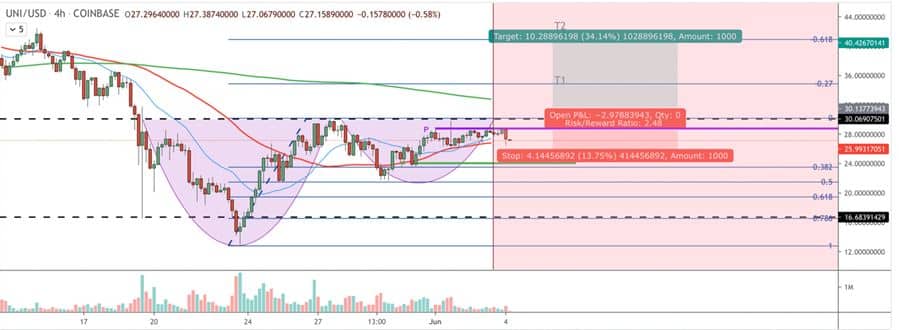
    Uniswap (UNI) has declined by nearly 3% in the past week – suggesting a bearish outlook for the cryptocurrency. UNI coin went as low as $15 amidst the market crash but has recovered since although the cryptocurrency has not begun an uptrend yet. At the time of writing, Uniswap (UNI) stands at a price level of $27.16. The price has been declining in the past twenty-four hours while the daily trading volume has been increasing.

    Uniswap (UNI) Technical Analysis

    The market sentiment for Uniswap is bearish as the cryptocurrency is declining. Out of the total technical indicators, eleven are giving out a signal of sell, eight are standing at a neutral position while seven are indicating a buy signal. Both the oscillators and moving averages are bearish.

    Uniswap (UNI) had been identified to have formed a cup and handle formation. The bullish formation had yet to be confirmed by the price movements; however, Uniswap failed to confirm the formation as the price did not break above the neckline. Uniswap can also be seen to have been rejected a few times at the price level of $28 – making it a major resistance level. The cryptocurrency is also being supported by the price level of $24. Currently on a downtrend, Uniswap can be expected to test the support level.

    Uniswap’s controversial proposal

    Harvard Law School Blockchain and FinTech Initiative has made a governance proposal to set aside funds for political lobbying in favor of DeFi as the threat of regulation looms. The proposal would finance political groups that are working against DeFi regulation. The proposal had been controversial as many stakeholders think it unfair for a few lawyers and a single organization to manage lobbying funds. However, the proposal had been gaining popularity as well. ConsenSys – the Ethereum solution provider – has also expressed its support for the proposal and after securing a majority of favorable votes, the proposal is set to move forward to a full vote stage.

  • BitMEX executives trial date is set for March 2022

    BitMEX executives trial date is set for March 2022

    New York District Judge John Koeltl has set the trial for former BitMEX executives CEO Arthur Hayes, co-founder Benjamin Delo, and chief technology officer Samuel Reed to be held on 28th of March 2022. The head of business development Gregory Dwyer also has to face charges but has not yet appeared. The trial is going to take place eighteen months after the charges were initially filed.

    Defense motions are due to be filed in June while other pretrial motions are expected to be filed by September 2021. The platform had been operating in a jurisdiction outside the United States because of lax regulation – as bragged by an executive – but had also been offering its services to American citizens.

    The three former executives of the cryptocurrency exchange, BitMEX, are accused of evading the anti-money laundering laws as well as the violation of the Bank Secrecy Act. The United States Commodity Futures Trading Commission had charged BitMEX with illegally operating as a derivatives platform. The commission further believes that the crypto exchange has been offering illegal leveraged trading services ever since its launch in 2014. The CFTC investigation has been going on since 2019 and the crypto exchange was given ample time to exclude Americans from its platform through the “Know Your Customer” requirements – which it failed to do so.

    A civil enforcement action was filed against the three executives who are said to own and operate the exchange as well as five entities, namely: HDR Global Trading Limited, 100x Holding Limited, ABS Global Trading Limited, Shine Effort Inc Limited, and HDR Global Services (Bermuda) Limited (BitMEX).

    Apart from civil charges, the four executives are also accused of conspiring to violate and violating the Bank Secrecy Act by the United States Department of Justice. The conviction can land the executives in prison for a maximum of five years with a heavy penalty of $250,000.

  • VeChain (VET) facing major resistance levels, here’s what to know

    VeChain (VET) facing major resistance levels, here’s what to know

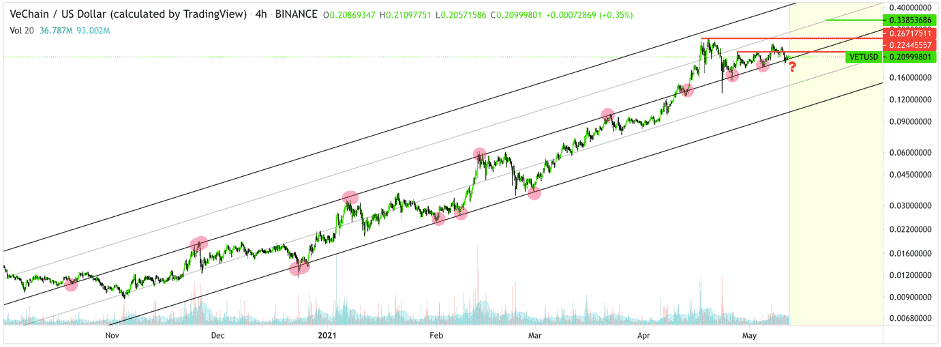
    VeChain (VET) has been highly volatile over the past few days with strong pullbacks and impulsive moves. At the time of press, VeChain crypto stands at price level of $0.20. In the twenty-four timeframe, the price of the cryptocurrency has fallen and so had the daily trading volume. VeChain crypto had been struggling ever since it had established its all-time high at $0.27 nearly a month ago; although, somewhat of an uptrend has been established recently but with high volatility.

    VeChain (VET) technical analysis


    Despite the somewhat downturn in the market, the sentiment is majorly bullish. Out of the total twenty-six technical indicators, twelve are giving out a signal of buy while nine are standing at a neutral position with only five indications of sell. The oscillators are mainly neutral while the moving averages are strongly bullish.

    A trader has identified VeChain (VET) crypto to be operating in multiple ascending channel formations. The trader expects the channelized behavior of VeChain’s price to continue in the coming days. Per the technicals of the cryptocurrency, the trader is expecting VeChain coin to grow – as the market is bullish. The trader has also identified resistance levels at $0.22 followed by $0.26 and finally at $0.33. If VeChain coin is able to break the identified resistance levels then it would indicate high bullish momentum and a possible upside breakout from the various channel formations.

    Developments in the VeChain (VET) community


    The VeChain Foundation recently announced it is delving into the NFT frenzy. The Foundation is actively working on promoting the adoption of the blockchain technology and for this purpose, the Foundation has announced a $1 million fund for VeChain Grant Program for developers and projects working on bringing value to the enterprise NFT or eNFT sphere.

    An application, E-HCert, based on the blockchain of VeChain in Cyprus is designed to fight the Coronavirus pandemic in the country. The VeChain-based solution will enable users to corroborate coronavirus test results.

  • Cardano (ADA) fighting the bears with multiple support levels

    Cardano (ADA) fighting the bears with multiple support levels

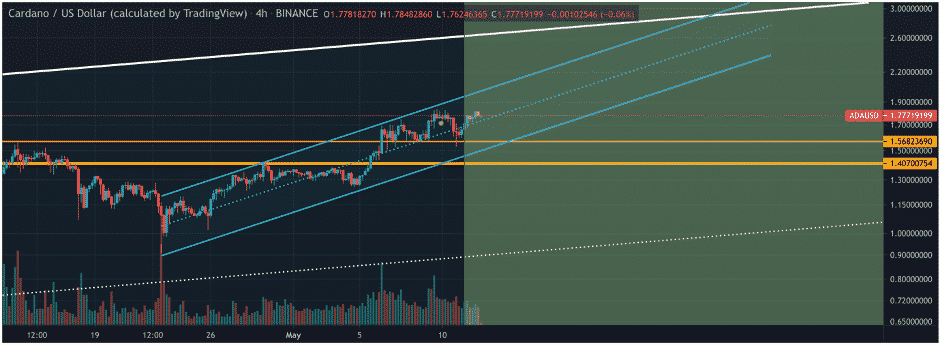
    Cardano (ADA) has been surging. Cardano coin has been on a steep upward trend since the beginning of May – adding to the bullish momentum. The cryptocurrency established a new all-time high at $1.83 a few days ago. At the time of writing, Cardano coin stands at a price level of $1.77. The price of the cryptocurrency has increased by 6% in the past twenty-four hours while the daily trading volume has decreased by 15%. Cardano crypto is ranked sixth in the market with a capitalization of $56 billion.

    Cardano (ADA) technical analysis


    The market sentiment for the cryptocurrency is bullish. Out of the total technical indicators, fifteen stand at a buy position while nine are giving out a neutral signal and only two are standing at a sell position. The oscillators are mainly neutral while the moving averages are bullish.

    A trader has identified Cardano crypto in an ascending channel formation. The channel had begun forming since the end of April and Cardano has been operating inside the channel ever since. An ascending support line has also been identified which dissects the channel in half. Cardano coin’s market outlook had turned bearish as the cryptocurrency fell below the support line inside the channel. However, it has ever since established the support level again as it stabilized in the level. Cardano is also facing support at $1.56 and $1.40. Per the trader, the renewed bullish momentum is the market will lead it towards higher highs.

    Why is Cardano (ADA) bullish?

    The organization behind Cardano, IOHK, is working tirelessly on the real-world uses of the cryptocurrency. Data from Google Trends show that interest in Cardano had begun rising since the end of January and peaked in middle of March. A further break down reveals that country-wise, Australia, Netherlands and Ireland have accounted for most of the interest in the cryptocurrency.

    IOHK has also announced a partnership in Africa. IOHK is working with the ministry of education in Ethiopia to roll out a blockchain-based student performance tracking system. The program will initially be launched for 5 million students and 750,000 teachers. This is a hallmark moment for not just Cardano but the cryptocurrency sphere as the project marks the world’s biggest blockchain deployment.