Tag: Price-to-Book Ratio

  • PB Ratio: Evaluating a Stock’s Value and Potential for Growth

    PB Ratio: Evaluating a Stock’s Value and Potential for Growth

    The price-to-book ratio, or PB ratio, compares a company’s market price per share to its book value per share. Evaluating a stock’s value and potential for growth is an essential skill for any investor.

    One important metric that investors use to assess a stock’s value is the price-to-book ratio. The P/B ratio can help investors determine whether a stock is overvalued or undervalued relative to its book value.

    But what does this mean for an investor? Well, a low PB ratio can indicate that a stock is undervalued and potentially a good investment opportunity.

    Conversely, a high P/B ratio can suggest that a stock is overvalued and may be at risk of a price correction.

    Additionally, the P/B ratio can help investors identify companies with growth potential, as a low P/B ratio may suggest that a company has room to grow and increase its book value over time.

    What Is PB Ratio?

    The price-to-book ratio compares a company’s stock price to the value of its assets as recorded on its balance sheet.

    One of the benefits of using the P/B ratio is that it can be used to compare the relative value of companies within the same industry.

    Market-to-Book Ratio

    • The market-to-book ratio (M/B ratio), also called price to book ratio, is a financial metric used to evaluate the market value of a company compared to its book value.
    • The market value represents the total worth of the company as determined by its stock price, while the book value represents the value of the company’s assets as recorded in its financial statements.
    • The M/B ratio is calculated by dividing the market value per share by the book value per share.
    • A company with an M/B ratio above 1 indicates that the market values the company higher than its book value, suggesting that investors are not confident in its future growth prospects.
    • On the other hand, a company with an M/B ratio below 1 indicates that the market values the company lower than its book value, suggesting that investors have high expectations for its future growth potential.

    How the Price-to-Book (P/B) Ratio Works

    By familiarizing themselves with the PB ratio, long-term investors can make informed decisions that will yield the best possible returns. So, let’s have a look at it.

    • Formula and Calculation of the Price-to-Book (P/B) Ratio

      It is calculated by dividing the market price per share of a company’s stock by its book value per share. The formula for calculating the P/B ratio is:

      Formula and Calculation of the PB Ratio

      where:

      Market Price per Share = Total market value of all outstanding shares of the company’s stock / Total number of outstanding shares

      Book Value per Share = Total shareholder equity / Total number of outstanding shares

      Once we have both the market price per share and book value per share, simply divide the market price per share by the book value per share to arrive at the P/B ratio.

    • What the Price-to-Book Ratio Can Tell You

      In essence, the P/B ratio tells us how much investors are willing to pay for each dollar of the company’s net worth.

      The P/B ratio is particularly useful for companies in industries with a lot of physical assets, such as manufacturing or transportation, as the book value is a significant factor in the company’s overall value.

      However, it may not be as useful for companies in industries with intangible assets, such as technology or pharmaceuticals, as the book value may not accurately reflect the value of these assets.

      Another way to interpret the P/B ratio is to compare it with the average P/B ratio for the industry.

    A Low Price-to-Book (P/B) Ratio

    A low PB ratio can indicate that a company is undervalued by the market, making it an attractive investment opportunity.

    There are a few reasons why a company may have a low P/B ratio.

    • Poor reputation

      One possibility is that the company is relatively unknown or has a poor reputation in the market. In this case, investors may be hesitant to invest in the company, which can drive down its P/B ratio.

    • Financial instability

      Another possibility is that the company has experienced financial difficulties or has a large amount of debt, which can negatively impact its book value and lead to a lower P/B ratio.

      Despite the potential risks associated with investing in companies with low P/B ratios, there are also significant benefits.

    • Substantial returns

      For one, investing in undervalued companies can provide investors with substantial returns if the market eventually recognizes the company’s true value.

    • Growth potential

      Additionally, investing in undervalued companies can provide investors with a sense of satisfaction, as they are able to identify and invest in companies with potential for growth.

    A High Price-to-Book (P/B) Ratio

    The stock market can be confusing and intimidating, with many terms and concepts that can seem overwhelming to the uninitiated.

    One such concept is the Price-to-Book (P/B) ratio, which is used to evaluate the value of a company’s stock.

    • What does a high P/B ratio tell?

      While there are many factors that can affect a stock’s PB ratio, a high P/B ratio is often seen as a sign of a company that is already performing well and has apparently little room for growth.

    • How do investors see the high P/B ratio?

      A high P/B ratio cannot be a good thing for investors, because it suggests that the company’s stock is trading at a premium compared to its book value.

      This can be an indication that the market has low expectations for the company’s future growth prospects, or that it has a weaker competitive advantage that restricts it to generate more profits than other companies in the same industry.

    • Prone to rapid market changes

      A company may have a high P/B ratio because of a recent acquisition or other one-time events, rather than because of its underlying fundamentals.

      Additionally, market conditions can change rapidly, and what was once seen as a high P/B ratio may become more average or even low over time.

      Despite these caveats, however, a high P/B ratio can be a useful indicator for investors who are looking for companies with growth potential and a competitive advantage in their respective industries.

    How to Calculate the PB Ratio

    To calculate the P/B ratio, we take the company’s stock price and divide it by its book value per share.

    How to Calculate the PB Ratio

    Let’s calculate the metric for Apple Inc (AAPL). As close of the market on Friday, February 24, 2023, AAPL’s stock price was $146.71. Similarly, as of the close of the recent quarter (Dec 31, 2022), AAPL had a Book Value per Share of 3.58.

    Calculate the PB Ratio

    This indicates that the current P/B ratio for AAPL stock is 40.98.

    Variations by Industry

    The PB ratio can vary significantly across different industries, reflecting the unique characteristics and dynamics of each industry.

    For example, in technology and software industries, companies with high P/B ratios may be more common due to the rapid pace of innovation and the potential for future earnings growth.

    In contrast, in industries such as utilities or real estate, companies with low P/B ratios may be more common due to the stability and predictability of their earnings.

    Moreover, the impact of variations in P/B ratios by industry can have a significant effect on investment strategies.

    Investors seeking growth may be more likely to invest in companies with high P/B ratios in the technology and software industries.

    Those seeking stability and dividends may be more inclined to invest in companies with low P/B ratios in the utilities and real estate industries.

    Examples of the Price-to-Book (P/B)

    Amazon and Tesla are two companies with high price-to-book (P/B) ratios, which indicate that investors are willing to pay a premium for their stocks.

    The price-to-book (P/B) ratio of Amazon is 6.71, while the average P/B ratio of companies in the S&P 500 index is 10.43. This suggests that Amazon’s stock is currently trading at a lower P/B valuation than the broader market average.

    The price-to-book (P/B) ratio of Tesla is 13.91, which is significantly higher than Amazon’s P/B ratio of 6.71. Additionally, Tesla’s P/B ratio is much greater than the industry average of 5.61. This suggests that the market is currently valuing Tesla’s stock at a premium relative to both Amazon and its industry peers.

    Despite concerns about sustainability, many investors are willing to pay even more of a premium for Tesla’s stock due to its disruptive potential.

    Disadvantages of Using the PB Ratio

    There are several disadvantages associated with its use.

    • Non-reflective of true value

      It only considers the company’s book value, which may not reflect the true value of the company’s assets. This can result in the undervaluation or overvaluation of a company.

    • Earnings or growth possibilities are not considered

      The metric does not consider the company’s future earnings potential or growth prospects, which can be important factors in determining a company’s value.

    • Accounting practices may impact

      It can be affected by accounting practices, such as the depreciation method used, which can vary between companies.

    • Companies in Distress

      When a company experiences distress, such as financial difficulties or operational challenges, its P/B ratio may decrease due to lower investor confidence in the company’s ability to generate profits and create value.

      This can lead to a decline in the stock price and potentially result in the company being undervalued.

    Conclusion

    The PB ratio is a simple yet powerful tool for investors looking to identify potentially undervalued or overvalued stocks.

    It is commonly used in combination with other fundamental and technical analysis techniques to help investors make more informed decisions about their investment choices.

    The P/B ratio can be used to compare a company’s stock price to its book value per share and is often used as a benchmark for evaluating whether a company’s stock is cheap or expensive relative to its peers.

    A low P/B ratio may indicate that a company’s stock is undervalued, while a high P/B ratio may suggest that a company’s stock is overvalued.

    FAQs

    How should investors interpret the P/B ratio when analyzing a stock?

    Investors can interpret the P/B ratio as a measure of a stock’s valuation relative to its book value. A lower P/B ratio may suggest that a stock is undervalued, while a higher P/B ratio may suggest that it is overvalued.

    Additionally, the P/B ratio may not be as relevant for companies that have a significant amount of intangible assets, such as technology firms.

    What is a good PB ratio?

    A good price-to-book (P/B) ratio can vary depending on the industry and the company’s circumstances.

    Generally, a P/B ratio less than 1 indicates that the stock is trading below its book value, which could be a good opportunity for value investors.

    However, a high P/B ratio may indicate the market is already paying a premium for the company’s assets or growth prospects.

    What are the p/b and p/e ratio?

    The price-to-book ratio compares a company’s market value to its book value, where a low P/B ratio suggests that a company may be undervalued, while a high ratio may indicate that the company is overvalued.

    The P/E (price-to-earnings) ratio, on the other hand, measures a company’s current share price relative to its earnings per share.

    A high P/E ratio may indicate that investors have high expectations for the company’s future earnings growth, while a low ratio may suggest that the company is undervalued or that investors have low expectations for its future growth.


  • Price to Sales Ratio: A Vital Tool for Stock Analysis

    Price to Sales Ratio: A Vital Tool for Stock Analysis

    Among the many metrics at the disposal of the typical investor, the price to sales ratio is usually the first that market participants use to determine whether or not to go forward with an investment decision.

    Top analysts often call it the superior valuation metric among most price ratios.

    In fact, several even go as far as to claim that the ratio stands as their all-time favorite among all investment metrics.

    Because of its reliability, it is the one tool market traders can turn to, regardless of the type of company they are looking to analyze.

    Investing in the stock market can be a daunting task, but with the right tools, you can make informed decisions.

    In this article, we’ll look at how the price to sales ratio (P/S) can help you understand a company’s true value and assess whether an investment is worth making.

    Furthermore, we will delve into the p/s ratio formula and elucidate the step-by-step process for calculating it, equipping readers with a comprehensive understanding of this indispensable metric.

    Read on to find out more about this powerful tool!

    What Is The Price To Sales Ratio?

    To answer the question, “What is the price to sales ratio?”, it can be defined as a metric used by investors to determine the current worth of stock.

    In its simplest understanding, the ratio is a mathematical expression whereby the price of a stock is divided by the revenue per share.

    This singular metric, when applied to a broader context, helps determine if the company is under or overvalued.

    On whatever basis one derives the P/S ratio, the end result will tell the investor how much the market is paying for each dollar of revenue the company earns.

    It is thus the most straightforward way of valuing a company, as it tells you if you are getting more or less for each buck you place. Based upon this interpretation, a range of market participants build up entire portfolios.

    P/S Ratio Formula

    The price to sales ratio formula is as follows:

    Price To Sales Ratio Formula

    How to Calculate P/S Ratio (Step-by-Step)

    Method 1

    P/S Ratio=Market Price per ShareRevenue per Share

    • Step 1

      Get the current price per share of the company’s stock. You can find this information on financial websites or by checking the stock ticker symbol.

    • Step 2

      Find the revenue per share. Look at the company’s financial statements or annual reports to get the total revenue.

      Then, divide it by the total number of shares outstanding to get the revenue per share.

    • Step 3

      Calculate the P/S ratio by dividing the market price per share by the revenue per share. This ratio gives you an idea of how much investors are willing to pay for each dollar of the company’s revenue.

      For example, let’s say the market price per share is $50, and the revenue per share is $10. In this case, the P/S ratio would be:

    P/S Ratio=$50$10=5

    Method 2 – How to Calculate P/S Ratio

    The P/S ratio is also calculated by dividing a company’s market capitalization by its total revenue. To put this into an equation, it looks like:

    P/S Ratio=Market Capitalization Total Revenue


    Let’s say we have a company with a market capitalization of $1 billion, and total revenue of $500 million. To calculate the P/S ratio, we’ll plug these values into the formula:

    P/S Ratio=1,000,000,000500,000,000=2


    In this example, the P/S ratio of the company is 2.

    Examples Of The Price-To-Sales (P/S) Ratio

    Now that we have discussed what the p/s ratio formula actually is, we can move on ahead and dive right into a real-world example for a stock valuation assessment.

    To do so, we will be working with the example of the renowned electric car company, Tesla Inc. (TSLA), and applying the P/S ratio to its specific context.

    We begin by carrying out the simple calculation that will tell us Tesla’s P/S Ratio:

    To calculate the Tesla price to sales ratio, we need two key pieces of information: the stock price and the sales revenue.

    Let’s assume the current stock price of Tesla is $234 per share, and the company reported $27.35 billion in revenue per share for the most recent fiscal year.

    To find Tesla’s P/S ratio, we divide the stock price by the revenue per share:

    P/S Ratio = $234 / $27.35

    Now we can calculate the P/S ratio:

    P/S Ratio = 8.56

    How To Analyze The Price-To-Sales Ratio?

    Now that we have the figure, we know that the market is presently paying $8.38 for each $1 of revenue Tesla turns over.

    In isolation, this metric does not really tell us much and certainly gives no clear indication if the current price of the stock represents an undervaluation or overvaluation.

    The best chance we have at interpreting this ratio is to tie the figure into a broader context.

    How To Analyze The Price To Sales Ratio.png
    Source: Macrotrends

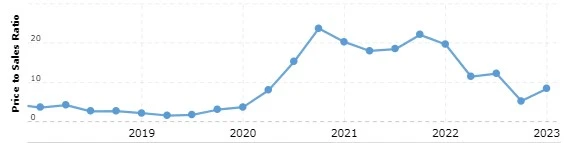
    Looking at the graph displayed above, it is apparent that Tesla’s price to sales ratio had been relatively stable from 2018 through to 2020, and then saw a drastic surge, entering 2021.

    Tesla was not alone in seeing such ballooning price multiples, as several tech-oriented companies experienced a similar phenomenon, in what came to be known as Big Tech’s pandemic bubble.

    The bear market of 2022 has since brought down Tesla price to sales ratio, yet it still remains considerably higher than its pre-pandemic levels.

    The market is yet to determine whether or not this indicates that Tesla’s overvaluation has largely seen a correction.

    Such an assessment would understandably require the use of other tools in conjunction with the P/S ratio.

    However, as can be seen, the ratio, on its own can provide a meaningful sense of direction to assist market participants in their investment decisions.

    How to Interpret Price-to-Sales Ratio (High or Low)

    When interpreting P/S ratios, it’s important to understand that there is no universal “good” or “bad” ratio.

    Generally, a low P/S ratio suggests that a company might be undervalued, while a high P/S ratio may indicate that the company is overvalued.

    However, the interpretation of what is considered a low or high ratio varies by industry and company.

    How to Interpret a High P/S Ratio

    A high P/S Ratio typically suggests that a company is overvalued or that investors are too optimistic about its future growth potential.

    In other words, if a company has a price-to-sales ratio that is much higher than its peers, it may be a signal that the company’s stock is overpriced relative to its sales revenue.

    A potential explanation for such high P/S ratios is that investors expect the company to have significant revenue growth in the upcoming years.

    If that’s not the case, however, it is possible for the stock to face a significant drop in value.

    High P/S ratios are often observed in technology-based companies that have a major disruptive potential or expensive products (such as biotech or pharma companies).

    How to Interpret a Low P/S Ratio

    On the other hand, a low price to sales ratio may indicate that a company’s stock is undervalued relative to its sales revenue.

    It may imply that investors haven’t recognized the potential of the company yet, so an opportunity for growth may exist.

    Alternatively, investors may prefer other metrics (such as Earnings Per Share or PE Ratio) when analyzing stocks, which could lead to a lower-than-expected P/S ratio.

    It is important to consider the ratio in conjunction with other metrics.

    An Example of Price-To-Sales Ratio Analysis

    Walmart Price-to-Sales Ratio Analysis

    As of June 8, 2023, Walmart’s price-to-sales ratio (TTM) is 0.6547. This means that investors are willing to pay 65.47 cents for every dollar of Walmart’s sales.

    Walmart’s price-to-sales ratio is below the average for the S&P 500, which is 1.75. This suggests that investors may be undervaluing Walmart’s (WMT) stock.

    There are a few reasons why Walmart’s price-to-sales ratio may be below the average for the S&P 500.

    1. Walmart is a mature company with a relatively stable business.
    2. Walmart is facing increasing competition from online retailers like Amazon.
    3. Walmart’s profit margins have been declining in recent years.

    Despite these challenges, Walmart remains a strong company with a dominant market share in the retail industry.

    The company is also investing heavily in its e-commerce business, which could help it to compete with Amazon in the future.

    Overall, Walmart’s price-to-sales ratio suggests that the stock may be undervalued.

    What Is An Average Price To Sales Ratio

    Another way the PS ratio interpretation can be carried out is by comparing the figure to the industry average, which would give a general picture of where the stock’s valuation stands in relation to its peers.

    This involves the comparison of the average price to sales ratio to that of other players operating in the EV manufacturing spaces.

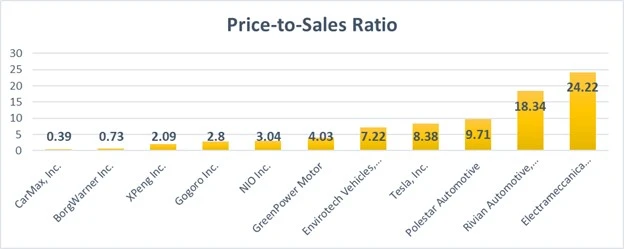
    As can be seen in the graphic below, it is apparent that Tesla is priced relatively higher than a wide range of players in its industry, but still below a handful of others such as Rivian Automotive (RIVN) and Electrameccanica Vehicles (SOLO).

    What Is An Average Price To Sales Ratio
    Stocks Telegraph

    Upon calculation of the mean, the average price-to-sales ratio of the industry amounts to 7.35, which is marginally below Tesla’s 8.56.

    Depending on the risk appetite of investors, as well as other information pertaining to the company’s finances, market participants may determine whether or not they deduce the stock to be undervalued or not.

    This then could guide towards a buy or sell decision, impacting their holding of TSLA on their wider portfolio.

    What Is A Good Price-To-Sales Ratio?

    Ideally, the investor must have access to a range of information in addition to the price to sales (p/s) ratio to finalize their position on a particular stock.

    The optimal ratio would depend on the particular company, industry, and even macroeconomic context.

    Although the general rule is that the lower the price to sales ratio, the greater the value opportunity, investors must take caution when the ratio is abnormally low, as this could be a red flag in specific cases.

    It is all within the realm of possibility that a company may be faced with circumstances that impact its future performance, such as a forthcoming permit cancellation or legal proceedings against the company.

    Even though these circumstances would not affect present sales figures, they present a grim picture looking forward.

    In such a case shareholders may be selling off the stock of such a company, which would lead to an extraordinarily low P/S ratio.

    This stresses for the importance of a holistic look into any stock one investigates, before arriving at a decision.

    Similarly, in many cases, a high P/S ratio does not always mean the investment opportunity is not always compelling, or even overvalued, which may be the case with Tesla Inc.

    In many instances, the pricing of a particular stock reflects not only its current performance but also the present value of its growth potential.

    In such a case, the market expects tremendous future growth and is thus driving up its stock price, despite low levels of current revenue.

    To account for this, some analysts use future sales per share in their calculations.

    But as a general rule of thumb, a higher than normal P/S ratio indicates overpricing, unless the company expects a forthcoming boom in performance (such as a commodity price rise, for instance).

    Why Is The Price To Sales (P/S) Ratio Useful To Investors?

    In the world of finance, every tool at the disposal of traders has its unique set of merits and demerits.

    The same goes for the P/S ratio, which continues to see praise from seasoned investors across the financial space. The following are the most useful aspects of the P/S Ratio:

    • Immunity From Manipulation

      Unlike earnings, revenue is recorded in a straightforward manner, making the price to sales (p/s) ratio a reliable tool to turn to for evaluating a company.

    • Allows For Evaluation of Loss-Making Companies

      The PS ratio works flawlessly even for loss making companies, on account of their revenue figures. It thus overcomes a critical limitation of the price to earnings (PE) ratio.

    • Ensures Peer Comparison

      The PS ratio is a great standard of comparison, especially when assessing the valuation of different companies in a given industry, operating at a similar scale of operations.

    • Allows For Historical Analysis

      One can gauge the improvements in the company’s valuation over time by using its average PS ratio as a benchmark level.

    What Are The Limitations Of The Price To Sales (P/S) Ratio?

    The P/S ratio has drawbacks and may not always be straightforward. The following are some of its limitations to be aware of:

    • Overlooks Critical Financial Information

      By making sales the sole basis of valuation, the PS ratio does not consider profitability, cash flow management, debt cover, asset utilization, and other critical aspects of the business.

    • No Distinction Between Profitable and Loss-Making Businesses

      The PS ratio could potentially make a loss-making company seem more attractive on a value basis, relative to a profitable company.

    • Does Not Consider Wider Demand of Stock Beyond Sales

      The market often values companies based on anticipated growth, which the PS ratio does not factor into its workings.

    Comparing Companies

    One of the major advantages of the price to sales ratio is that it can be used to compare companies that operate in the same industry, regardless of their size or profitability.

    For example, if we want to evaluate two companies that operate in the same industry, we can look at their P/S ratios to determine which one is trading at a higher valuation.

    By doing so, we are comparing these companies based on their ability to generate revenue, rather than their net income or earnings per share.

    Additionally, the P/S ratio can be useful in comparing companies that are not profitable yet, as it is based on revenue rather than earnings.

    For instance, if we want to analyze two startup companies that have yet to turn a profit, we can use their P/S ratios to see which one is generating more revenue compared to its valuation.

    • Tesla

      Tesla, Inc. (TSLA), the electric vehicle maker, has a current P/S ratio of approximately 8.56. This means that investors are willing to pay $8.56 for every dollar of Tesla’s revenue.

      This may seem high compared to some other companies, but Tesla is a rapidly growing company that has had impressive revenue growth over the past few years.

    • Amazon Price to Sales Ratio

      Amazon (AMZN), the e-commerce giant, has a current P/S ratio of around 2.37. This price-to-sales ratio for growth company AMZN is lower compared to Tesla price to sales ratio.

      However, Amazon is a profitable company that has a considerable market share in the retail and technology industries.

      Therefore, investors may be willing to pay more for Tesla’s revenue compared to Amazon.

    • Netflix

      Looking at price-to-sales ratio for growth company, Netflix, Inc. (NFLX) has a P/S ratio of around 5.65. This is higher compared to Amazon price to sales ratio but lower compared to Tesla’s.

      Netflix is a growing company that has expanded rapidly over the past few years, thanks in part to its successful content strategy and international expansion.

    • Alphabet

      Alphabet Inc. (GOOG), the parent company of Google, has a P/S ratio of around 6.02. This is lower compared to Tesla’s P/S ratio and higher compared to Amazon’s.

      Alphabet is a highly profitable company that generates the majority of its revenue from online advertising.

    • Meta Platforms

      Meta Platforms, Inc. (META) has a P/S ratio of around 6.01. This is higher compared to Amazon price to sales ratio and lower compared to Tesla’s.

      Meta is a growing company that generates the majority of its revenue from advertising.

    • Alibaba

      Alibaba Group Holding Limited (BABA), the Chinese e-commerce giant, has a P/S ratio of around 6. This is lower compared to Tesla’s P/S ratio and higher than Amazon’s.

      Alibaba is a company that has been experiencing rapid growth, thanks in part to its dominance in China’s e-commerce landscape.

    Price to Sales Ratio vs Price Earnings Ratio

    Another valuation ratio that is commonly used in stock analysis is the price to earnings ratio (P/E). The P/E ratio compares a company’s market capitalization to its earnings per share (EPS).

    While both the P/S and P/E ratios are valuation metrics, they represent different aspects of company performance.

    The P/E ratio provides insight into a company’s profitability by showing how much investors are willing to pay for each dollar of earnings.

    Meanwhile, the P/S ratio provides insight into a company’s ability to generate revenue.

    Problems with the Price to Sales (P/S) Ratio

    While the P/S ratio can be a useful tool, it also has its problems.

    One issue with the P/S ratio is that it is more suitable for certain industries, such as retail or technology, where revenue is a crucial factor in determining a company’s success.

    In other industries, such as the financial or energy sectors, the P/S ratio may not be as applicable.

    Additionally, the P/S ratio does not take into account a company’s debt or cash holdings.

    A company with a significant amount of debt or a low cash balance may have a higher P/S ratio compared to a company with little to no debt and a larger cash balance.

    How to Use the PS Ratio Properly

    When using the P/S ratio for stock analysis, it is important to keep in mind that it is just one of several valuation ratios.

    It should not be used in isolation but rather in conjunction with other metrics, such as the P/E ratio and the company’s financial statements.

    It is also important to look at a company’s historical P/S ratio to see how it has changed over time.

    A company with a decreasing P/S ratio may indicate that the market is becoming less bullish on the company.

    Conversely, a company with an increasing P/S ratio may indicate that investors are becoming more optimistic about its future prospects.

    What is the Price-to-Sales Ratio NOT Good For?

    The Price-to-Sales (P/S) ratio, while it can be handy in some cases, has its limitations and might not be the best indicator in certain situations.

    Here are a few instances where the P/S ratio may not be all that helpful:

    • Profitability Assessment

      The P/S ratio doesn’t take a company’s profitability or earnings into account.

      So, if a company is not making much profit or even running in the red, the P/S ratio won’t give you a clear picture of its financial health.

    • Industry and Business Model Differences

      Every industry and business model has its own quirks when it comes to profitability and generating revenue.

      Comparing P/S ratios across different industries or companies with distinct business models may not give you meaningful insights.

    • Future Growth Potential

      The P/S ratio is all about the present – it doesn’t consider a company’s growth prospects or potential.

      It’s possible that a company with great growth potential may have a higher P/S ratio due to investors’ expectations, but the ratio alone won’t show you that.

    • Comparing Apples to Oranges

      P/S ratios are most useful when comparing companies in similar growth stages.

      Comparing the P/S ratio of an established, stable company with that of a high-growth startup won’t give you a fair assessment of their valuations.

    • Ignoring Debt and Capital Structure

      The P/S ratio doesn’t take into account a company’s debt levels or capital structure.

      So, companies with different debt situations or capital structures may end up with different valuations, even if their revenue levels are similar.

    Conclusion

    The price to sales ratio is a remarkable tool that offers much utility to those that are identifying top-value stocks.

    It is a superior metric, in many regards, to some of the most popular approaches, including the price-to-earnings ratio, due to its high degree of reliability.

    It offers investors a simple way to determine the value of a stock, by demonstrating how much each dollar of revenue from the company is worth in the market.

    By comparing this figure to past trends of the same company, or carrying out a broader industrial comparison, market traders may be able to determine whether or not a stock is undervalued.

    FAQs

    Is A Higher or Lower Price-To-Sales Ratio Better?

    As a rule of thumb, the lower the Price-to-Sales Ratio, the more undervalued a company may potentially be. However, all assessments of such a nature must be paired in with other metrics for a more holistic conclusion to be derived.

    How Do You Evaluate Stocks?

    Stocks are evaluated on the basis of a range of metrics, such as price ratios that may potentially reveal whether a stock is over or underpriced.

    Price ratios, such as the price-to-sales ratio, rest on the assumption that the market has priced each stock on the basis of a particular metric, such as sales or earnings.

    What Are the Indicators of a Good Stock?

    A good stock typically shows low price ratios, high growth metrics, compelling analyst ratings, and a range of other indicators.

    Many investors look to institutional ownership to assess a stock’s reliability, whereas others focus on insider activity.

    What Are The 3 Methods of Stock Valuation?

    Investors can pick from three distinct forms of stock valuation, which draw their conclusions from distinct dimensions of the business. These are:

    • Market-based method
    • Income-based method
    • Asset-based method