Tag: technical analysis of stock

  • How to Use Technical and Fundamental Analysis Together

    How to Use Technical and Fundamental Analysis Together

    Introduction

    Understanding what to buy and when to buy it is important when investing in the stock, particularly if your objective is steady income. Technical analysis and Fundamental analysis are two of the most effective methods used by investors. Each provides insightful information on its own. However, when combined, they can offer you a comprehensive competitive advantage.

    This article examines how income-focused investors can avoid expensive entry points, find solid dividend-paying stocks, and create a dependable income-generating portfolio by combining technical and fundamental analysis. We’ll also show you how to use the Stocks Telegraph Screener to implement these tactics.

    Fundamental Analysis (Intro)

    A company’s long-term worth and financial stability are examined by fundamental analysis. Income investors, who depend on a company’s capacity to maintain and increase dividend payments over time, should pay particular attention to this.

     Important factors to look at:

    Dividend yield & payout ratio help you understand whether the dividend can be sustained.
    Earnings Per Share (EPS) gives an idea of whether profits show a steady upward trend.
    Free cash flow tells if there is sufficient money available to pay dividends.
    Debt-to-equity ratio shows whether the business has too much debt.
    P/E, P/B, and PEG valuation metrics show if the stock is undervalued or overvalued.

    These metrics help you understand: “Is this company financially strong and worth owning for the long term?”

    Technical Analysis (Intro)

    Technical analysis primarily concentrates on chart patterns, trading volume, and price action. It helps traders make decisions, when to purchase or sell stocks.

    Important Factors to keep an eye on:

    • 50-day, 200-day moving averages show trends and possible entry points.
    • The Relative Strength Index (RSI) tells if a stock is overbought or oversold.
    • MACD (Moving Average Convergence Divergence) highlights momentum changes
    • Support & Resistance Levels identify entry or exit zones

    In short, this side of the analysis tells whether it is now a good time to enter or wait for a better price.

    Why Income Investors Should Combine Both

    Relying only on fundamentals can lead you to buy good companies at bad times (e.g., during a price dip). Meanwhile, using only technicals may cause you to trade based on momentum, missing the long-term income potential of a stock.

    When used together:

    • Fundamentals help you choose what to invest in.
    • Technicals help you decide when to invest.

    If you use them together, it ensures you’re picking high-quality dividend stocks at the right time, maximizing income, and minimizing downside.

    How to Use Both Together – Step-by-Step

    Let’s walk through a real-world income-investing scenario:

    Step 1: Use the Stocks Telegraph Screener for Fundamentals

    Go to the Stocks Telegraph Screener and apply filters like:

    • Dividend Yield ≥ 4%
    • Payout Ratio ≤ 60%
    • Free Cash Flow Positive
    • P/E Ratio ≤ 15
    • Debt/Equity ≤ 1

    This will give you a list of financially solid dividend stocks. You’ve now screened for companies that can sustain income payouts.

    Step 2: Pull Up the Stock Chart for Technical Analysis

    After finding a strong fundamental pick, use any free charting platform (e.g., TradingView, Yahoo Finance) and look for:

    • RSI—If it’s below 30, the stock might be oversold (good entry point).
    • Moving Averages—Look for the stock trading above the 50-day MA (bullish trend).
    • MACD Crossover—A bullish crossover could signal a momentum shift.
    • Support Level—Is the stock bouncing off a key support zone?

    If the stock is fundamentally strong and technically positioned for a bounce or rally, you’ve found a potential gem.

    Example: Combining Both Analyses

    Let’s say you find Pfizer (PFE) on the Stocks Telegraph Screener:

    • Dividend Yield: 6.0%
    • Payout Ratio: 60%
    • Free Cash Flow: Strong
    • Debt Levels: Manageable

    Now you check the chart:

    • RSI is 32 (approaching oversold)
    • The price is near the 52-week support
    • MACD shows a bullish crossover

    Conclusion? It could be a solid dividend pick with a smart entry point.

    Tip for Investors

    Dividend Reinvestment Plans (DRIPs) can be a very good choice if you are using this strategy for long-term income growth. It enables your dividends to compound your income over time by automatically purchasing additional shares.

    Watch Out for These Pitfalls
    • Don’t buy just because the technicals look good. Check the fundamentals first.
    • Don’t ignore valuation. A high dividend yield could be a red flag if earnings are declining.
    • Technical indicators aren’t always accurate—combine multiple signals before making a decision.
    Tools to Make This Easier
    Tool Use
    Stocks Telegraph Screener Filter stocks with strong dividends & fundamentals
    Yahoo Finance View financials, charts, and analyst ratings
    TradingView Deep technical charting with custom indicators
    Morningstar For dividend safety ratings & stock valuation

    Final Thoughts: Best of Both Worlds

    As an income-focused investor, you’re not just chasing flashy price swings — you’re building a consistent cash flow stream. But that doesn’t mean you should ignore timing.

    By blending technical and fundamental analysis, you can:

    • Avoid weak or risky dividend traps
    • Buy high-quality stocks at favorable prices
    • Build an income stream that grows and compounds over time

    Use the Stocks Telegraph Screener to start building your watchlist today—and make smarter, more strategic investment moves.

  • Fundamental Analysis of Stocks: A Comprehensive Guide

    Fundamental Analysis of Stocks: A Comprehensive Guide

    Assessing investments in the stock market through fundamental analysis of stock is a critical approach. It involves examining a company’s financial and economic fundamentals to determine its intrinsic value.

    By mastering the fundamentals of stock analysis, investors can make informed investment decisions and achieve long-term financial goals. Investing in the stock market can be a profitable option, but it requires understanding how to analyze stocks.

    Therefore, it is essential to understand fundamental analysis, which is one of the primary methods for evaluating stocks. As a beginner investor, it’s crucial to learn the basics of fundamental analysis of the stock.

    In this article, we will provide a comprehensive guide to fundamental analysis, covering key factors to consider when analyzing stocks.

    What Is Fundamental Analysis?

    Fundamental analysis is an important method that investors use to assess the true value of a stock. It involves examining various financial and economic factors, including revenue, earnings, assets, liabilities, and management, as well as market trends and macroeconomic indicators to determine whether a stock is over or undervalued.

    To conduct a fundamental analysis of a stock, investors typically examine financial statements like income statements, balance sheets, and cash flow statements, as well as qualitative factors like the regulatory environment, competitive landscape, and management team.

    Additionally, investors use fundamental analysis of the stock market to evaluate whether the market as a whole is overvalued or undervalued. This process involves evaluating macroeconomic variables like GDP growth, inflation rates, interest rates, and political stability, as well as market trends like trading volume and price-to-earnings ratios.

    By understanding how to do a fundamental analysis of stocks and the fundamental analysis of the stock market, investors can identify undervalued stocks and generate superior returns.

    Importance of Fundamental Analysis

    Fundamental analysis plays a crucial role in the investment decision-making process as it provides investors with a comprehensive understanding of a company’s financial health and market value.

    One of the key benefits of fundamental analysis is its focus on a long-term perspective, unlike technical analysis, which is mainly used for short-term trading opportunities.

    The long-term approach allows investors to evaluate a company’s performance based on essential fundamentals, rather than short-term market fluctuations, and assess its potential for growth over an extended period.

    Furthermore, fundamental analysis enables investors to identify undervalued stocks that have the potential for future growth. Investors can unearth concealed opportunities and determine if the present market price reflects a company’s intrinsic worth by scrutinizing its financial statements.

    Sources for Fundamental Analysis

    There are several sources for fundamental analysis of stock, including financial news websites, stock analysis websites, and company filings such as annual reports and quarterly earnings statements.

    In addition, there are several key metrics that investors should pay attention to when conducting fundamental analysis, such as the price-to-earnings ratio, the price-to-book ratio, and the dividend yield.

    Example

    Let’s take Apple Inc. (AAPL) as an example for conducting fundamental analysis. Here are some factors that an investor might consider:

    • Financial Statements: The investor might analyze Apple’s income statement, balance sheet, and cash flow statement to assess its financial health. For example, they might look at the company’s revenue growth, profit margins, and cash flow generation.
    • Company Reports: The investor might review Apple’s annual and quarterly reports to gain insights into the company’s operations, financial performance, and risks. They might look for information about Apple’s products and services, customer base, and competition.
    • Industry Reports: The investor might analyze industry reports to gain insights into the technology sector in which Apple operates. They might look for information about the size and growth prospects of the market, the competitive landscape, and regulatory trends.
    • Economic Data: The investor might consider economic data such as GDP growth, inflation, and interest rates to assess the macroeconomic environment in which Apple operates. For example, they might look at trends in consumer spending and technology investment.

    Intrinsic Value

    One of the key concepts in the fundamental analysis of the stock is intrinsic value, which is the true value of a company based on its financial and economic fundamentals.

    To determine a company’s intrinsic value, investors can use various methods such as discounted cash flow analysis, which involves projecting a company’s future cash flows and discounting them back to their present value.

    Example

    Here’s an example to illustrate the concept of intrinsic value:

    Let’s say you’re considering buying shares of XYZ Corporation. The current market price of each share is $50. To calculate the intrinsic value of the stock, you’ll need to estimate the future cash flows of the company and discount them to their present value. Let’s assume that:

    XYZ Corporation is expected to generate $5 per share in annual earnings for the next 5 years. After that, earnings are expected to grow at a rate of 5% per year indefinitely. The required rate of return for the investor is 10%.

    Using these assumptions, you can calculate the intrinsic value of the stock as follows:

    Present value of earnings for the next 5 years = ($5 / (1 + 10%)^1) + ($5 / (1 + 10%)^2) + ($5 / (1 + 10%)^3) + ($5 / (1 + 10%)^4) + ($5 / (1 + 10%)^5) = $18.88

    Present value of future earnings beyond 5 years = ($5 * (1 + 5%)^5) / (10% – 5%) = $82.84

    Intrinsic value of the stock = Present value of earnings for the next 5 years + Present value of future earnings beyond 5 years = $18.88 + $82.84 = $101.72

    Based on this calculation, the intrinsic value of XYZ Corporation’s stock is $101.72, which is higher than the current market price of $50. This indicates that the stock may be undervalued, and investors may want to consider buying it.

    The Difference Between Technical and Fundamental Analysis

    Technical analysis of the stock is another method that involves scrutinizing charts and technical indicators to identify trends and patterns in stock prices. However, this technique is mainly useful for short-term trading and fails to provide a comprehensive view of a company’s financial performance.

    In contrast, fundamental analysis emphasizes long-term investing and provides a more detailed assessment of a company’s true value.

    Although technical analysis of stock can be a valuable tool for day traders seeking quick profits, fundamental analysis is essential for long-term investors interested in understanding a company’s financial strength and potential for growth.

    Quantitative and Qualitative Fundamental Analysis

    Fundamental analysis can be divided into two main categories: quantitative analysis and qualitative analysis.

    Quantitative Analysis

    Quantitative analysis involves the use of numerical data to evaluate a company’s financial performance. In order to determine a company’s profitability, growth potential, and overall financial health, it is important to examine financial statements, ratios, and other quantitative data. Some of the key quantitative analysis methods used in stock investing include:

    • Financial Ratio Analysis

      This involves using financial ratios to evaluate a company’s financial health. Common ratios used in the fundamental analysis include price-to-earnings (P/E), price-to-sales (P/S), return on equity (ROE), and debt-to-equity ratio.

    • Discounted Cash Flow (DCF) Analysis

      This involves projecting a company’s future cash flows and discounting them back to their present value to arrive at an intrinsic value for the company.

    • Earnings Per Share (EPS) Analysis

      This requires an evaluation of a company’s earnings per share to ascertain its profitability and growth potential.

    Qualitative Analysis

    Qualitative analysis involves the use of non-numerical data to evaluate a company’s prospects. This encompasses consideration of a company’s industry, competitive position, management team, and overall business strategy. Some of the key qualitative analysis methods used in stock investing include:

    • SWOT Analysis

      This method evaluates a company’s strengths, weaknesses, opportunities, and threats to gauge its competitive position and future prospects.

    • Industry and Market Analysis

      This method assesses the industry and market in which a company operates to determine its growth potential and competitive position.

    • Management Analysis

      This method evaluates a company’s management team to assess their track record and ability to execute on the company’s business strategy.

    • Brand Analysis

      This method assesses a company’s brand reputation to determine its competitive position and future growth potential.

    The Business Model

    A company’s business model is the way it generates revenue and profits. Investors should analyze a company’s business model to determine its sustainability and potential for growth.

    For example, a company with a subscription-based revenue model may have more predictable and recurring revenue than a company with a one-time sale revenue model.

    Competitive Advantage

    A company’s competitive advantage refers to the unique qualities that allow it to outperform its competitors.

    Investors should analyze a company’s competitive advantage to understand how it differentiates itself from its competitors and whether it can maintain its competitive edge in the long run.

    Management

    A company’s management team plays a crucial role in its success. Investors should analyze a company’s management team to understand their experience, track record, and leadership style.

    How To Read The Annual Report Of A Company?

    The annual report of a company contains a wealth of information that can be used in fundamental analysis. Investors should pay attention to the following sections of the annual report:

    • Financial statements: These include the balance sheet, income statement, and cash flow statement.
    • Management’s discussion and analysis: This section provides an overview of the company’s financial performance and operations.
    • Notes to the financial statements: These provide additional information about the financial statements.

    How To calculate Fundamental Analysis?

    Calculating fundamental analysis involves analyzing a company’s financial statements and using a variety of metrics to evaluate its financial health and potential for growth. Some of the most important metrics to consider include revenue growth, earnings per share, price-to-earnings ratio, and return on equity.

    To calculate these metrics, investors can use financial software or online tools to access a company’s financial statements and perform the necessary calculations. By doing so, investors can gain a better understanding of a company’s financial health and make informed investment decisions.

    The Components of Fundamental Analysis

    Fundamental analysis is comprised of several key components that investors use to determine the intrinsic value of a stock. These components include:

    • Income Statement: The income statement shows the company’s revenue, expenses, and net income over a period of time. Investors use this information to analyze the company’s profitability.
    • Balance Sheet: The balance sheet shows the company’s assets, liabilities, and equity at a specific point in time. Investors use this information to analyze the company’s financial health and stability.
    • Statement of Cash Flows: The statement of cash flows shows the company’s cash inflows and outflows over a period of time. Investors use this information to analyze the company’s ability to generate cash and manage its finances.
    • Management Discussion and Analysis (MD&A): MD&A is a section of the annual report where management discusses the company’s financial performance, operations, and future prospects. Investors use this information to assess the company’s strategic direction and management effectiveness.
    • Footnotes: Footnotes provide additional information about the financial statements and accounting practices used by the company. Investors use this information to gain a deeper understanding of the company’s financials and potential risks.

    Statement of Cash Flows

    The statement of cash flows is a critical component of fundamental analysis. It shows the cash inflows and outflows of a company over a period of time. There are three sections of the statement of cash flows:

    • Cash from operating activities (CFO): This section shows the cash generated by the company’s core operations.
    • Cash from investing activities (CFI): This section shows the cash used for investments in property, plant, and equipment, as well as other long-term assets.
    • Cash from financing activities (CFF): This section shows the cash used for financing activities, such as issuing and repurchasing stock or paying dividends.

    Pros and Cons of Fundamental Analysis

    Like any investment strategy, fundamental analysis of stock has its pros and cons.

    Pros

    • Provides a comprehensive view of the company’s financial health
    • Helps identify undervalued or overvalued stocks
    • Enables investors to make informed investment decisions based on the intrinsic value of a stock
    • Focuses on long-term investment opportunities

    Cons

    • Requires a significant amount of time and effort to perform the analysis
    • Can be subjective and open to interpretation
    • May not account for short-term market trends and fluctuations
    • Does not always predict future performance accurately
    • Despite these limitations, fundamental analysis remains a valuable tool for investors who are willing to do their due diligence and make informed investment decisions.

    Conclusion

    Fundamental analysis of a stock is an indispensable tool that enables investors to evaluate a company’s financial strength and long-term potential. Compared to technical analysis, which focuses on short-term trading opportunities, fundamental analysis provides a more comprehensive view of a company’s underlying financial health.

    To carry out fundamental analysis, investors must assess a range of key financial indicators, including earnings, revenue, assets, liabilities, and management. Investors can leverage these factors to ascertain if a company is undervalued or overvalued and recognize possibilities for future growth.

    Additionally, fundamental analysis can help investors build a diversified investment portfolio that aligns with their investment goals and maximizes their returns over time. However, it is essential to note that fundamental analysis requires time and effort to carry out effectively.

    In summary, whether you are a beginner or an experienced investor, understanding the fundamentals of stock analysis is crucial for success in the stock market. With a comprehensive guide to the fundamental analysis of stocks, investors can develop the skills and knowledge necessary to achieve long-term financial goals.


  • Stock Resistance Level: Navigating Price Plateaus and Breakouts

    Stock Resistance Level: Navigating Price Plateaus and Breakouts

    Have you ever seen analysts and traders obsessing over price charts, studying all sorts of lines? As it turns out, some of these plain old lines are actually quite insightful and help the market make more informed decisions. In the realm of the financial markets, the stock resistance level is an important indicator that market players use to guide their buying or selling decisions. Through this many can optimally time their entry and exits from positions.

    In many cases, the knowledge of the stock resistance level determines whether or not a trader’s move has been profitable. This is because this technical indicator is a great predictor of price movement, helping traders move accordingly.

    Overall, resistance levels are incredibly helpful markers that financial players often consult. We shed light on this important tool to help you make more informed decisions, armed with better information on price trends in the market.

    What are stock resistance levels?

    A stock resistance level is simply a point beyond which a particular price is unable to move beyond. Just as its name implies, there is a high degree of resistance in the market which obstructs the security from surpassing the given price.

    To those watching the markets, it is extremely useful to know which are the levels beyond which stocks are unable to overcome resistance. When they do manage to break through, the reaction from the market is usually extraordinary.

    These levels of resistance are also useful for everyday trading situations. For instance, if a stock has risen substantially, and cannot progress beyond a certain point, it may be a good time to sell it off, with little chance of further gains.

    Similarly, when a stock does break through a point of resistance, market bulls would typically rush it, to ride the growth wave. They would likely do so until a new resistance level is made clear.

    How to Use stock resistance level?

    Investors can use chart patterns and technical analyses to identify levels of resistance relating to particular stocks in the market. By assessing historical trends on patterns, traders may pick out consistent points of resistance.

    Once market players are certain of which levels a stock’s price can not normally climb beyond, they could use this information to their advantage in the following ways:

    • Pre-resistance level

      When a certain stock approaches its level of resistance, it may reverse its growing trend, so selling it at that point may be a prudent move.

    • Post-resistance level

      If a stock does manage to break past its resistance level, traders may likely hold on to it to capture additional growth, until a new resistance point is shown.

      Through this simple, yet highly effective approach, market participants could optimize their trading performance. By using stock resistance levels, they would effectively know the limits of the gains they aim for.

    Example of stock resistance level

    Now that we have a basic idea of what the level of stock price resistance actually represents, we can dive right into a real-world example, and examine its application for traders.

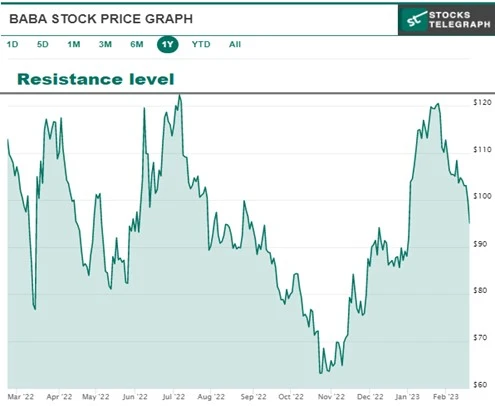
    We take a look at the Chinese e-commerce king, Alibaba Group Holding (NYSE: BABA), over the last 12 months:

    Example of stock resistance level
    Source: Stocks Telegraph

    As can be seen in the price trend above, the $122 point has consistently acted as the limit to BABA’s growth in the last 12 months. It is evident that the market simply does not let its pricing get beyond $122.

    The stock hit its 12-month high in July at the resistance point, but what followed was a crashing fall. Similarly, it had risen to a similar level in early 2023, only to have hit a ceiling, sending it back down to double-digit prices.

    Those that identified this level of resistance had potentially saved themselves from serious capital loss, having sold BABA close to its highs. Others holding on to it know when they may continue on their long position.

    The Difference Between Resistance Level and Support Level

    Another concept that goes hand in hand with price resistance is that of support levels. A support level is the flip side of a resistance level, as it establishes a floor, beneath which a stock usually never falls to.

    Since both are barriers, resistance prices show decreases in demand and increases in supply, whereas support levels show increases in demand and decrease in supply.

    Similarly, resistance and support levels together are good indicators of market sentiment. They show the points where the market considers a stock to be over and undervalued, respectively.

    In fact, with the shift in market sentiment, a support level can become a level of resistance, and a level of resistance can transform into a support level. Below are examples of each:

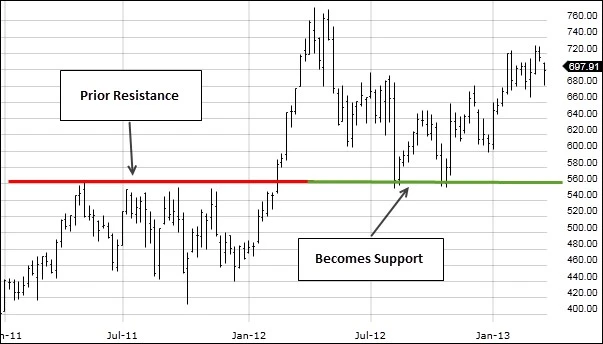
    • Resistance Level becoming Support Level

      Often when new information enters the market, and fundamentals show improved growth potential previous resistance prices do not seem so overvalued, and demand begins to increase at those levels.
      When this happens, prior resistance points end up forming a new support baseline, translating to an upward surge in the price. This is demonstrated in the example below:

      Resistance Level becoming Support Level
      Source: Fidelty Investments
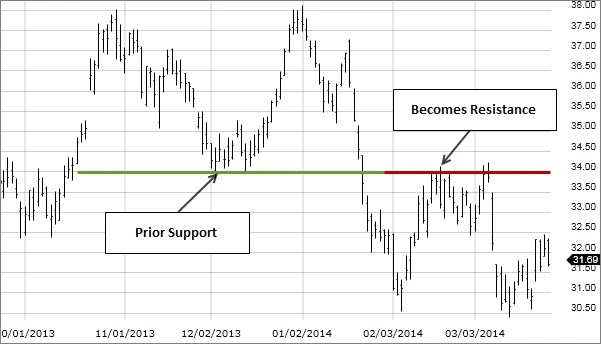
    • Support Level becoming Resistance Level

      Similarly, as market sentiment shifts, it is also likely that a prior support level can end up acting as a new resistance point for a particular stock trading in the market. This comes about due to shifting trends.

      With the market taking on a more pessimistic stance, the support level seems to overprice the stock, which causes it to plunge, and not rise beyond the previous support level, which now becomes a resistance point.

      Support Level becoming Resistance Level
      Source: Fidelty Investments

    Limitations of stock resistance level

    While using resistance lines offers a great degree of utility and assistance to market traders, it is important to keep in mind the limitations that are inherent to these tools. These are listed below as follows:

    • Unpredictability

      Resistance prices should not be assumed to be set in stone, as these shifts rapidly and quite unpredictably. Trading strategies must regularly be updated based on new market dynamics, without reliance on outdated assumptions.

    • Incomplete assessment

      Relying solely on resistance and support lines is a dangerous approach, as it is important to make an investment decision based on a complete picture. Company fundamentals, macro conditions, and sentiment should all be considered.

    • Irrelevance

      With respect to certain stocks, resistance points may not be a relevant factor. This is especially when patterns and technical bearings have no significance, in volatile markets, or after major news events.

    • Subjective Interpretation

      Levels of resistance are not objective calculations and are usually interpreted subjectively. For this reason, different players may disagree on where these lines are seen, if at all. This leads to confusing signals and uncertainty.

    Psychology of support and resistance

    The concept of support and resistance, although does not necessarily have a bearing on a stock’s fundamentals, it very much relates to the mindset of market participants. In fact, support and resistance both boil down to psychology.

    Stock resistance levels come into formation when buyers and sellers collectively agree that a certain price is too high for a particular stock to be trading at. It is essentially an overvaluation by mindset.

    The same is true for support levels. These shared beliefs about a stock’s adequate valuation impact buying and selling, which establishes precise supply and demand dynamics. These then go on to set trend lines as resistance and support.

    The psychology of traders is what directly sets these lines. For this reason, these can be great tools for gauging market sentiment. It is important to remain aware of the limitations of human psychology. Some of these pitfalls are as follows:

    • Overconfidence

      When market players overestimate their trading strategies, leading them to take on unjustifiable risks.

    • Emotional reactions

      Fear and greed can cause traders to act impulsively.

    • Herd behavior

      Following the behavior of the wider market without your own investigation.

    • Confirmation bias

      Ignoring information that contradicts your viewpoints.

    • Loss aversion

      Not accepting a loss, and holding on to that position indefinitely.

    Factors that Influence Resistance Levels

    There is a range of factors that go on to influence the levels of resistance seen across the market. Understanding these could help traders predict the behavior of these barriers, and when breakthroughs will occur. These factors are:

    • Demand and Supply

      At its most fundamental level levels of resistance form due to demand and supply dynamics. At prices where supply outweighs demand, resistance forms, whereas the opposite case gives rise to support levels.

    • Trader Psychology

      While demand and supply may be the most fundamental factor, it is driven by traders’ mindset and sentiment. Due to psychological reasons, players overbuy and oversell stocks within a precise range, which forms levels.

    • Macroeconomic Environment

      Wider macroeconomic indicators also influence which price points show resistance.
      When GDP growth is high, inflation is moderate, and employment data is positive, demand for financial securities are typically high. This raises the levels of resistance significantly.

    • News updates

      When positive updates appear in the market, about the prospects of a company, its stock resistance level undertakes quite the climb. In this case, the previous resistance becomes the new support level.

    Conclusion

    Stock resistance levels are incredibly useful measures that traders often use in their analysis. They point out the barriers to a price trend beyond which stocks are supposedly unable to climb beyond.

    These levels of resistance are caused by demand and supply dynamics, which are directly driven by trader psychology at a collective level.

    There are several factors that cause resistance to form at certain price levels. Understanding these factors can help market players to predict the formation and behavior of these levels of resistance.

    It is important to note, however, that relying solely upon resistance and support levels to guide trading is seriously risky. For the best trading strategy, a holistic approach must be taken, while considering in all relevant factors.

    FAQs

    What if a stock price breaks through a resistance level from below?

    If a stock price breaks through a resistance level from below, there is an indication of a bullish signal, caused by a surge in demand for the stock. This typically means a major price rise is imminent.

    How to find the resistance level of a stock trending upwards?

    To identify the level of resistance for an upward-trending stock, one would need to look at the historical price chart for the stock. Through this, previous highs can be studied, and upward barriers can be pointed out.

    What is strong resistance in the stock market?

    In the stock market, strong resistance is a situation where the supply for a stock heavily outweighs its current demand. This may be due to a large number of short-sellers betting against the stock.