Tag: what is a call option

  • Explaining Call Options: Basics and Strategies

    Explaining Call Options: Basics and Strategies

    What is a call option? If you’re new to options trading, this question may have crossed your mind. It is a question most face when they make their entry into this dynamic and lucrative space, where participants are looking to win big.

    If you’re looking to navigate the world of options trading, understanding this fundamental concept is crucial. Call options are powerful financial instruments that could act as a game-changer, especially if applied correctly.

    Call options offer unique opportunities for investors and traders to speculate on price movements, hedge against risks, and enhance their investment strategies.

    In this article, we will deconstruct exactly what is a call option, and explore its wider significance. We also discuss how they can be utilized in different investment strategies.

    So, let’s dive into the world of call options and discover how they can enhance your trading skills and help you achieve your financial goals.

    What Is A Call Option?

    To start off, we dive right into our question at hand; what is a call option?

    Simply put, a call option is a type of financial contract that gives you the right, but not the obligation, to buy a specific amount of an underlying asset, like a stock or a commodity, at a set price within a certain timeframe.

    Due to the nature by which they function, call options could basically be understood as “reservations” placed to buy an asset at a fixed date, and with a fixed price.

    One of the key things to understand about call options is that they give you the right, but not the obligation, to buy the underlying asset.

    This means you can choose not to exercise the option if the stock price doesn’t go up as you anticipated, and you would only lose the premium paid for the option.

    What Are Puts And Calls?

    Now that we have set the stage by discussing what is a call option, we can take a step back and talk about what are puts and calls.

    We have mentioned that call options are essentially derivative contracts that give the holder the right, but not the obligation, to acquire an asset at a fixed price, on a fixed date.

    Puts are simply the other side of the coin to this arrangement. They give the holder the right, but not the obligation, to sell an asset for a fixed price, on a fixed date.

    Together, puts and calls make up the foundation of options trading. They are typically used by investors and traders to speculate on price movements in the underlying asset, manage risks, and optimize their investment portfolio.

    Options traders turn to both puts and calls to achieve a number of strategic outcomes. These include hedging against potential losses, generating income through options selling, or speculating on market direction.

    Buy To Open Vs Buy To Close

    It is impossible to thoroughly understand what is a call option, without getting into the phenomenon surrounding ‘buy to open vs buy to close.’

    Essentially, each of the two phrases introduced above reflects different processes that take place during options trading. The ‘buy to open’ process takes place when an investor initially acquires a call option.

    Buy to open means a market player has entered a new call position on a particular asset, with a fixed price and fixed expiration date. The player anticipates a particular asset to climb in price, which he or she will buy at a lower price, and profit.

    Alternatively, the buy to close process refers to the process of closing an existing call option position by buying back the call option contract that was previously sold.

    This is typically done to exit a call option position before the expiration date. It can be used to capture profits, limit losses, or adjust an overall investment strategy.

    What Is An Options Trader?

    The next question we investigate is ‘What is an options trader?’. It is important to understand an options trader, as it would help shed light on the nature of options trading and the derivative market itself.

    An options trader is a market player who is primarily involved in the buying and selling of derivative contracts known as options. Both calls and puts are types of options, and they are the core focus of an options trader’s activities.

    An options trader uses options to speculate on the price movements of the underlying asset or to hedge their existing positions.

    By using options, traders can potentially benefit from market volatility, take advantage of leverage, and construct complex trading strategies to manage risk and maximize returns.

    How Do Option Calls Work?

    At this point, we have not only uncovered what is a call option but have also gone over some crucial details. But all of this knowledge is meaningless without an understanding of the question, ‘How do option calls work?’.

    In the steps below, we demonstrate how option calls work, and enable their holders to turn in a profit when the price of the underlying asset experiences a climb:

    • Purchase an Option Call Contract

      The buyer purchases an option call contract that gives them the right, but not the obligation, to buy an underlying asset at a particular strike price before a specific expiration date.

    • Pay a Premium

      In order to complete the purchase, a premium would need to be paid for the option call. This is the cost of the transaction and would determine the profitability of the trade.

    • Watch for the Price Movement of Asset

      After acquiring the option call, the holder must monitor when the price of the underlying asset climbs beyond the strike price, making it economical to exercise.

    • Exercise the Call Option

      When the price of the asset surpasses the strike price, the option is exercised. When doing so, the holder would essentially be buying the asset at a much lower price than what the market demands, as had been set in the contract.

    • Profit

      Having exercised the option and having bought the asset at a much lower price than the market, the holder would typically sell back the asset to the market at the prevalent price, and profit off the difference between the strike price and spot price.

    How To Calculate Call Options Profit?

    Before making a call option trade, it is important to understand how to calculate call option profit to determine the potential return on investment.

    A critical variable during profit calculation in this context is the breakeven point. This refers to the strike price of the contract, plus the premium paid for acquiring it. The option will be profitable as long as the price of the underlying asset rises beyond this breakeven point.

    If the current market price is higher than the break-even point, then the profit is equal to the current market price minus the break-even point minus the premium paid.

    The profit through the use of call options is potentially unlimited, whereas the extent of the loss cannot go beyond the premium paid for the call option.

    How To Make Money On Call Options?

    Learning how to make money on call options can be a valuable skill for investors looking to profit from the price movements of underlying assets in the financial markets. Through this, traders can potentially earn significant profits in both bullish and bearish market conditions.

    There are two primary ways of making money on call options. These are as follows:

    • Exercising the Call Option Above Breakeven

      This means exercising the call and buying the underlying asset at a price lower than the current market price and then selling it at the current market price, making a profit.

      If the call option expires before the breakeven point, it may not be profitable to exercise it.

    • Buy a Call Option at a Low Price and Sell it at a Higher Price

      This involves buying a call option at a price lower than its true value, and selling it when its value has increased, resulting in a profit. Timing is key, as the value of the call option can fluctuate based on market conditions and other factors.

      Usually, the call option would be more valuable the higher the spot price of the underlying asset is, as it would be more profitable to its holder.

    Limitations

    There are three primary drawbacks when it comes to call options, that options traders must be aware of, before committing to an options-based strategy. These are discussed below as follows:

    • Cost Structure

      Call options require an upfront premium payment, which can be costly, especially for options that are deep out of the money or have a long expiration date.

      Additionally, as the expiration date approaches, the premium can increase, further limiting potential profits.

    • Narrow Time Frame to Exercise

      Call options have an expiration date, meaning that investors have a limited amount of time to exercise their options. If the stock price does not move in the desired direction before the option’s expiration date, investors may lose their entire investment.

    • Volatility

      While high volatility can potentially increase the value of call options, it can also lead to significant losses if the price of the underlying asset moves in the opposite direction.

      Only traders comfortable with this degree of volatility must engage in options trading. Inexperienced traders may find it difficult to accurately predict the direction of price movements, leading to losses.

    Conclusion

    In this article, we have attempted to answer the question of what is a call option, in-depth. We explored the notion that call options can be valuable tools for investors looking to speculate on or hedge against potential price movements in the underlying asset.

    By purchasing a call option, investors have the right to buy the underlying asset at a predetermined price, which can provide significant leverage and potential profits.

    This right opens them up to unparalleled flexibility and versatility that cannot be achieved in the regular, non-derivative financial markets.

    It is important to note, however, that call options come with risks, such as the possibility of the underlying asset not reaching the predetermined price or the option expiring worthless.

    As with any investment, it’s crucial to do your due diligence and thoroughly understand the mechanics of call options before trading them.

    FAQs

    What is the Strategy of the Call Option?

    The strategy of the call option is to purchase the right to buy the underlying asset at a set price and to profit from a potential increase in the asset’s value above this set price.

    What are the 4 Types of Call Options?

    There are four main types of call options, including American call options, European call options, long call options, and short call options.

    What are the Basics of Selling Call Options?

    The basics of selling call options involve selling the contract to generate income from the premium received or to hedge against an existing long position. Selling a call option also allows the seller to potentially profit if the underlying asset remains stagnant or decreases in price.
  • Call Option Strike Price: Definition and Importance for Traders

    Call Option Strike Price: Definition and Importance for Traders

    Although stocks remain one of the primary investment classes in the financial markets, there is no denying the booming growth of the derivatives market, since the 1970s. Derivatives refer to securities that derive their value from elsewhere, for instance, the price of a commodity. The call option strike price is one of the most fundamental concepts of the derivatives market, and understanding it can open one up to a world of opportunity. For this reason, it stands tall among the most studied domains in finance.

    The one who has grasped the notion of the strike price, and how best to align it to one’s strategy has mastered the basic derivatives market. In light of this, we attempt to explore this area and uncover its most sailing realities.

    In this article, we attempt to deliver a complete picture of the call option strike price, to give our readers the chance to take their first step in winning big in the derivatives market.

    What Is a Strike Price?

    When dealing in the derivatives market, one of the most popular financial securities in trade is options. As the name suggests, these contracts give their holders the option to purchase or sell an asset at a predetermined price.

    The option is therefore a right, and not an obligation, so it is useful for its holders in volatile price markets. This is a crucial reality to understand when answering, what is a strike price in options trading.

    The option to buy is referred to as a call, whereas the option to sell is a put.

    This now brings us to the strike price, which is crucial in this entire arrangement. It refers to the price a person buys or sells an asset, due to exercising their particular option. The strike price in each of these options would be independent of, and distinct from prevailing spot prices.

    An Example using Tesla Inc. (NASDAQ: TSLA)

    To illustrate by example, we can assume an individual with an option to purchase Tesla Inc. (NASDAQ: TSLA) at $150. The higher TSLA trades above the $150 point, the higher the gain to the individual.

    In the above example, $150 is the call option strike price. If we assume the option is exercised when TSLA is trading at $220, the gain for the holder would be $70 upon exercising.

    However, the trader would not exercise when the stock is trading below the stock price of $150.

    Understanding Strike Prices

    Within the whole discourse surrounding the derivatives market, it is crucial to understand that the value of the option one holds is tied clearly to its strike price, and when this is exercised.  Let’s take a look at both dimensions of the concept:

    • Call Options

      In the case of call options, which refer to the right to buy an underlying asset at a predetermined price, the option remains valuable to the holder, so long as the prevailing spot price is above the strike price.

      This is because, in an option to buy something, there is an economic benefit to acquiring the underlying asset at a price lower than the wider market is paying to get it. It would make no economic sense to pay higher than every other market player.

    • Put Options

      Turning over to put options, we see the flip side of the coin. As mentioned above, put options refer to the right to sell a particular asset at a predetermined price. In this case, it would remain valuable when the strike price is higher than the spot price.

      When a put option holder gets to sell an asset higher than the market is selling, there is a clear economic benefit, and thus the chance to earn capital gains.

    Strike Price of a Call Option

    Now that we have uncovered exactly what is a call option, we can take a more in-depth look at its dynamic and intricate relationship with the strike price. The call option strike price is characterized by the following three principles:

    • Option’s Intrinsic Value

      It is important to note that the very intrinsic value of a call option rests upon the strike price embedded within it. Subtracting this strike price from the current market price determines the gain to be made, and hence its intrinsic value.

      In the case where the market price is lower than the strike price, exercising the call would result in a loss, and thus at that point its intrinsic value would be negative.

    • Option’s Time Value

      Similarly, a call’s time value is also influenced by its strike price. This is because the more time elapses, the likelihood of the option being profitable would be impacted directly.

      For example, if a strike price is the above market price, the call would not be profitable to exercise. And the closer the expiry date of the option approaches, the lower the chance of the market shifting to a more profitable position for the option.

    • Probability of exercising

      Just like strike value determines intrinsic and time value, it also plays a major role in whether the call would be exercised at all. If the call option strike price is unrealistically unprofitable it may never come to use at all.

      This is why strike prices must be set in light of actual market realities and projections. It would have minimal demand if market players see no utility in holding it.

    Types of Strike Prices

    Now that we have laid out a comprehensive answer to the question, ‘what is a strike price in options trading?’, we move on to enrich our understanding by looking at the various types, that are common in derivative lingo. These are as follows:

    • In the Money (ITM)

      The strike price is said to be ‘in the money’ when it is profitable in relation to the spot price. In the case of call options, the strike price will be in the money so as long as it is below the spot price, making it economically valuable to its holder.

    • At the Money (ATM)

      When the strike price is categorized as being ‘at the money’, it means strike and spot prices are currently equal, and there would be no difference whether it is exercised or not. In this particular instance, the intrinsic value would equal zero.

    • Out of the Money (OTM)

      The final type of strike price is ‘out of the money’, referring to the instance where the strike price is in a loss-making zone, relative to market price. In the call option case, the strike price is OTM whenever it is above the prevailing market price.

    Strike Price vs Option Delta

    As explained above, an option holds intrinsic value, and, just like with stocks, its price in the market can differ from this intrinsic value, based on how valuable the market perceives it to be.

    One measurement that is central in this discussion surrounding an option’s intrinsic value, is the option delta. This relates to the sensitivity of an option’s price in relation to changes in the underlying asset’s market price.

    Option delta’s have an intricate, yet indirect relationship with the strike price, which is critical to understand. In the case of the call option strike price, generally, the higher the price of the underlying asset, the higher the value of the call.

    This is straightforward to perceive because calls would be highly in demand, the more expensive the asset is, the greater the likelihood of being in the money. Holders would gain tremendously by purchasing these assets via call.

    Similarly, the more the spot price falls of a particular asset, its calls would lose value, because it would be more economical to buy directly, than through a predetermined strike price.

    Strike Price Example

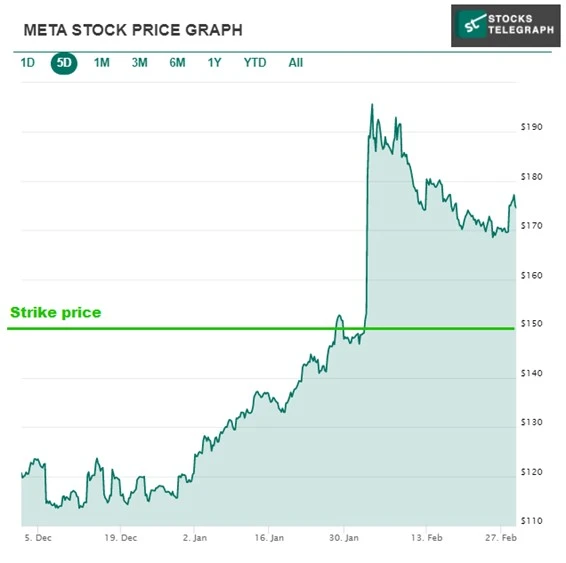
    To illustrate the above concepts of call option strike price by way of an example, we turn to take a look at the rising price trajectory of Meta Platforms Inc. (NASDAQ: META), and how a strike price may apply in its case:

    Strike Price Example: call option strike price
    Source: Stocks Telegraph

    In the graph above, we look at the price trajectory of META over three months, with a call option strike price of $150. This option remains OTM right till early February, and thus is not exercised.

    With the onset of February, however, META undertakes a phenomenal climb above the strike price, making the option’s intrinsic value drastically higher, due to it being ITM, and profitable.

    If we assume the option being exercised on the 27th of February, at a $175 price, the holder would have made a $25 gain through the option. This would have resulted in a loss if exercised at a point where META was trading below the green line.

    Are Strike Prices and Exercise Prices the Same?

    Strike price and exercise price typically represent the same phenomenon and thus are used interchangeably by market participants. This particular price is embedded in every call or put option and is maintained until its expiry date.

    The strike price is also called the exercise price because it is the price that is exercised via the option, regardless of where the spot price of the underlying asset is at. Normally, the option would not be exercised when the strike price is out of the money.

    What Determines How Far Apart Strike Prices Are?

    Often options traders deal in calls or put with multiple strike prices, allowing them to exercise at the most economically advantageous one while delivering flexibility. Often the distance between these strike prices is assessed closely by traders.

    There are two major aspects that determine how far apart these strike prices usually are:

    • Volatility

      In the case of highly volatile assets, the strike prices for the option would typically have a large distance between them, to cater to the large price swings. Conversely, the distance would be narrow in the case of stable underlying assets.

    • Expiration date

      Normally, the farther away the option’s expiration date is, the more distant its strike prices would be. This is because, with more time, the price could undertake major rises or falls, whereas the probability for this would be low in the near term.

    Factors to choose your Strike Price

    As a trader dealing with options, there are a number of factors you may consider before finalizing a strike price that works best for you. Some of these are described below as follows:

    • Risk Tolerance

      The strike price selected would ultimately depend on how risk tolerant the holder is. For one with a high-risk appetite, a distant strike price would be acceptable, which offers the prospect of large gains, despite low probability.

      Conversely, a market player with a very low tolerance for risk would be comfortable with a strike price that is as close to the current price of the asset as possible.

    • Risk-Reward Payoff

      Risk – Reward payoff also plays a major role in determining what strike price is ideal for each trader. Some prefer to be compensated a higher degree for the risk they assume, whereas others are okay with a lower degree of compensation.

      This balance would differ from person to person and would determine what strike price would be acceptable to each.

    • Implied Volatility

      This refers to how much the market expects a particular underlying asset to be volatile. A more volatile stock means the option being in the money would have a low probability.

      For such stocks with high implied volatility, traders may go for strike prices that are close to the current market price.

    • Volume/Liquidity

      High volume and liquid stocks are typically popular with the market, and thus the chance of gain through options would not be very high. In such cases strike price would be very close to the spot price trajectory.

    Conclusion

    The strike price is a very important element of the derivatives market, especially in the context of call options. The call option strike price refers to the price at that a holder can buy an underlying asset at, regardless of its current price.

    Understanding the call option strike price is important, because it directly translates into a gain for the holder, depending on how far below it is from the spot price of the underlying asset.

    There is a range of factors that influence strike prices, and also many that are influenced by it. It is an essential concept, the knowledge of which could see traders take on epic capital gains in the derivatives markets.

    FAQs

    What happens when the call option hits the strike price before expiration?

    When the call option hits the strike price before the expiration, the strike price would be in the money (ITM) and can be exercised to deliver a gain to its holder.

    What is the value of a call option with a strike price of $21?

    To work out the value of a call option with a strike price of $21, one would need to take into consideration a range of information. Some of the factors to consider would be the asset’s current price, implied volatility, interest rates, and time to expiration.

    How to price a 3-month call option with an at-the-money strike?

    To price a 3-month call option with an ‘at the money’ strike, you would need to use a pricing model, such as the Black-Scholes model, which factors in figures such as current price, implied volatility, time to expiry, and interest rate.