Tag: what is a market cap crypto

  • How To Calculate Market Cap? Formulas & Examples

    How To Calculate Market Cap? Formulas & Examples

    Market capitalization, or simply “market cap,” is the ultimate measure of a company’s value in the eyes of investors.

    But it makes how to calculate market cap critical for them as it represents the total dollar value of a company’s outstanding shares.

    It is also a key indicator of a company’s growth potential and financial health.

    Understanding market capitalization is essential for any investor looking to build a profitable portfolio.

    Market capitalization is a vital metric for investors to gauge a company’s value and potential.

    It reflects the market’s perception of a company’s worth and can influence investment decisions.

    A company’s market cap can determine its inclusion in stock indices, attract or repel investors, and impact its ability to raise capital.

    So how to calculate market cap is crucial for navigating the stock market.

    What Is Market Capitalization?

    Market capitalization is a commonly used metric in finance to assess the size of a company and its overall value in the market.

    This figure is derived by multiplying the total number of outstanding shares of a company by its current market price per share.

    In simpler terms, market capitalization represents the total market value of a company’s outstanding shares.

    What It Tells About The Company?

    Market capitalization is a key metric used by investors to evaluate a company’s size, its potential for growth, and its overall performance.

    Knowing how to calculate market cap is a critical component of various financial analyses, including the calculation of important ratios such as price-to-earnings ratio (P/E ratio) and earnings per share (EPS).

    Why Market Cap Matters?

    Market capitalization plays a crucial role in investment decisions, as it provides insight into the risk-return potential of a company.

    Investors can use the metric as a tool to diversify their portfolios and manage risk by investing in companies of different sizes.

    • Assessing A Company’s Size And Growth Potential

      Market cap is an essential tool for investors to gauge a company’s size, as it reflects the total value of all outstanding shares.

      Investors often use the market cap to compare companies in the same industry or sector and determine which one is larger or has more growth potential.

    • Reflects Market Sentiment

      The market cap also reflects market sentiment towards a company. A company with a high market cap is generally considered to be more stable and less risky than a company with a lower market cap.

      It can also indicate that the company has a strong brand, a competitive advantage, and is well-positioned for growth.

    • Helpful For Portfolio Construction

      Investors can also use the market cap as a tool for portfolio construction. They may choose to invest in large-cap companies, which are often more stable and have a history of consistent earnings.

      Alternatively, they may invest in small-cap companies with high growth potential but are riskier.

    • Influencing Stock Index Weighting

      Market capitalization is also important in determining the weight of a stock in an index.

      For example, in a market-cap-weighted index like the S&P 500, companies with higher market caps have a larger impact on the index’s overall performance.

      As such, market cap influences the performance of index funds and other investment vehicles that track market-cap-weighted indexes.

    The Limitations of Market Cap

    While market capitalization is a widely used metric to assess the size and value of a company, it is important to recognize its limitations in providing a comprehensive evaluation.

    Here are some key limitations of market cap:

    • Narrow Focus

      Market cap solely considers the current stock price and the number of shares outstanding, without taking into account other important factors such as a company’s financial health, growth prospects, management quality, or competitive advantage.

      It provides a limited perspective on the overall value and potential of a company.

    • Volatility and Short-Term Fluctuations

      Market cap can be highly volatile and susceptible to short-term market fluctuations.

      Changes in investor sentiment, market conditions, or specific company news can cause significant swings in market cap, which may not necessarily reflect the underlying fundamentals of the business.

    • Industry and Sector Bias

      Market cap comparisons are more meaningful within the same industry or sector.

      Comparing the market caps of companies from different industries may not provide an accurate reflection of their relative value or growth potential.

    • Lack of Consideration for Debt and Liabilities

      Market cap focuses solely on the equity value of a company and does not account for its debt or other liabilities.

      Companies with high debt levels may have inflated market caps, leading to an inaccurate assessment of their financial strength.

    • Influence of Large-Cap Stocks

      Market cap calculations can be heavily influenced by a few large-cap stocks within an index or market.

      This can distort the overall market cap picture and overshadow the performance or potential of smaller-cap companies.

    How To Calculate Market Cap?

    Market capitalization is a measure of a company’s total value. It is calculated by multiplying the company’s current share price by the number of outstanding shares.

    Here are the step-by-step instructions for how to calculate market cap.

    • Determine The Current Share Price

      The first step in how to calculate market capitalization is to determine the current share price of the company’s stock.

      This information can be obtained from financial websites or through a stockbroker.

    • Find The Number Of Outstanding Shares

      The next step is to determine the number of outstanding shares of the company’s stock. This information can be found in the company’s financial statements or on financial websites.

    • Multiply The Share Price By The Number Of Outstanding Shares

      The final step in how to calculate market capitalization is to multiply the company’s current share price by the number of outstanding shares. The result is the company’s market capitalization.

    Market Cap and Investment Strategy

    Here are how market cap influences investment strategies:

    • Growth vs. Value Investing

      Market cap is often used to categorize stocks into different investment styles.

      Large-cap stocks, typically those with a market cap above $10 billion, are often associated with stability and established market presence, making them attractive to value investors seeking steady returns.

      On the other hand, small-cap and mid-cap stocks, with lower market caps, tend to offer higher growth potential and are favored by growth investors looking for rapid appreciation.

    • Risk and Volatility

      Market cap can indicate the risk and volatility associated with a stock.

      Generally, small-cap stocks are considered riskier due to their potential for greater price fluctuations and higher company-specific risks.

      Large-cap stocks, with their established market positions, may exhibit lower volatility and be perceived as more stable investments.

    • Diversification

      Market cap diversification is an essential aspect of portfolio management.

      Investors often allocate their portfolios across stocks of different market caps to balance risk and returns.

      By holding a mix of large-cap, mid-cap, and small-cap stocks, investors can benefit from a combination of stability, growth potential, and diversification.

    • Sector Exposure

      Market cap can influence sector exposure within an investment strategy.

      Certain sectors, such as technology or healthcare, may be dominated by specific market cap segments.

      Investors seeking exposure to a particular sector may need to consider the market caps of stocks within that sector to ensure appropriate representation.

    • Long-term vs. Short-term Investment

      Market cap considerations can vary based on the investment horizon. Large-cap stocks are often seen as suitable for long-term investments, providing stability and potential dividends.

      Small-cap and mid-cap stocks may offer higher growth potential over the long term but may be subject to more significant short-term fluctuations.

    Misconceptions About Market Caps

    Market capitalization is a widely used metric in the financial world, but there are some misconceptions surrounding its implications and limitations.
    Here are a few misconceptions about market caps:

    • Market Cap Reflects a Company’s Value

      One common misconception is that market cap directly reflects the intrinsic value or worth of a company.

      While market cap provides an estimate of a company’s total market value, it does not necessarily reflect its true underlying value.

      Market cap is determined by multiplying the stock price by the number of outstanding shares, which can be influenced by various factors like investor sentiment and market dynamics.

    • Larger Market Cap Means Better Investment

      Another misconception is that larger market cap companies are always better investments than smaller ones.

      While large-cap companies are often well-established and may offer stability, they may not always provide the same growth potential as smaller companies.

      It’s important to consider other factors like financial health, industry trends, and the competitive landscape when evaluating investment opportunities.

    • Market Cap Determines Stock Performance

      Market cap alone does not determine a stock’s performance.

      A company’s financial performance, management quality, industry dynamics, and market conditions play significant roles in driving stock prices.

      Investors should focus on comprehensive analysis rather than relying solely on market cap to assess potential investment returns.

    • Market Cap Defines Risk Level

      Assuming that the market cap defines the level of risk associated with a stock is a misconception.

      While smaller-cap stocks can be more volatile and carry higher risks due to their size and liquidity, risk should be evaluated based on a range of factors, including company-specific risks, industry dynamics, and overall market conditions.

      A large-cap company can also be exposed to risks if it operates in a highly competitive or disruptive industry.

    • Market Cap is Static

      Market caps are not fixed and can change over time as stock prices fluctuate and companies issue or buy back shares.

      Market cap is a dynamic metric influenced by supply and demand dynamics in the market, investor sentiment, and company-specific events.

    What Is the Importance of Market Cap?

    Market capitalization is an important metric in the financial world for several reasons:

    • Size and Scale

      Market cap provides an indication of a company’s size and scale in the market.

      It reflects the total value of a company as determined by the stock market, representing the collective opinion of investors.

      Companies with larger market caps are generally considered to have more resources, established operations, and a broader market presence.

    • Investment Categorization

      Market cap is commonly used to categorize companies into different segments: large-cap, mid-cap, and small-cap.

      This classification helps investors in portfolio construction and asset allocation strategies.

      Different market cap segments have distinct characteristics in terms of risk, growth potential, and market dynamics, allowing investors to diversify their portfolios based on their investment goals and risk tolerance.

    • Benchmarking and Comparison

      Market cap provides a basis for benchmarking and comparing companies within the same industry or sector.

      Investors can use the market cap to assess a company’s relative size and performance compared to its peers.

      It helps in evaluating market share, competitive positioning, and the ability to attract investors and strategic partners.

    • Liquidity and Trading Volume

      Market cap is closely related to a stock’s liquidity.

      Companies with larger market caps typically have higher trading volumes and greater liquidity, making it easier for investors to buy or sell shares without significantly impacting the stock price.

      Higher liquidity generally reduces transaction costs and enhances the efficiency of the market.

    • Perception and Investor Confidence

      Market cap can influence investor perception and confidence in a company.

      A higher market cap is often associated with stability, credibility, and a track record of success.

      It can attract institutional investors and provide a sense of security to retail investors, increasing overall confidence in the company’s prospects.

    • Index Composition

      Many market indices, such as the S&P 500 or the Dow Jones Industrial Average, use the market cap as a criterion for including or weighing companies in the index.

      The performance of these indices is widely tracked and used as a benchmark for investment performance, making market cap an important factor in index investing and passive investment strategies.

    Market Capital Formula

    To calculate the total value of any company, the market capital formula would be as follows:

    Market Cap Formula

    Types Of Market Cap: Overview And Characteristics

    Market capitalization is typically divided into three categories:

    1. Large-cap
    2. Mid-cap,
    3. Small-cap

    However, we could add mega caps, micro caps, and nano caps to get a more comprehensive picture of a company’s valuation.

    • Large Cap

      These are typically large and well-established companies with a market capitalization of over $10 billion. They are usually leaders in their industry and have a proven track record of stability and consistent growth.

      They tend to have a lower risk profile and are considered to be less volatile compared to smaller companies.

    • Mid Cap

      These are companies with a market capitalization between $2 billion and $10 billion. They are smaller than large-cap companies but have greater growth potential.

      They may be less established than large-cap companies but have already demonstrated some degree of success.

    • Small Cap

      These are companies with a market capitalization between $300 million and $2 billion. They are often younger companies with high growth potential but may be less established and more volatile than larger companies.

    • Mega Cap

      These are companies with a market capitalization of over $200 billion. They are the largest of all publicly traded companies and are often household names with a global presence.

    • Micro Cap

      These are companies with a market capitalization between $50 million and $300 million. They are generally small, emerging companies with high growth potential, but are also considered high risk due to their size and lack of liquidity.

    • Nano Cap

      These are companies with a market capitalization of less than $50 million. They are often newly formed or very small companies and are considered to be very high risk due to their small size, limited resources, and lack of liquidity.

      These stocks are often thinly traded and may be subject to extreme price fluctuations.

    Market Cap Vs. Enterprise Value

    Market capitalization and enterprise value are two commonly used measures to evaluate the value of a company in the financial world.

    While both are used to determine the company’s worth, they take different factors into consideration.

    Measure Market Cap Enterprise Value
    Definition Total value of outstanding shares Market cap + total debt – cash and cash equivalents
    Calculation Current stock price x outstanding shares Market cap + total debt – cash and cash equivalents
    Includes Only equity Equity and debt
    Purpose Measure company’s size and market share Measure the company’s true value including debt
    Used for Comparison of company’s size with competitors Determine the cost of acquiring the company

    Examples Of Market Cap Calculation

    As of close of the trading on April 25, 2023, Apple Inc (AAPL) had a stock price of $163.77 per share and has 15.82 billion outstanding shares.

    So, moving towards how to calculate market cap of AAPL by applying market cap formula will be as follows:

    Examples Of Market Cap Calculation

    Similarly, Beamr Imaging Ltd. (BMR) closed the trading at $1.44 per share with number of its outstanding shares counting 12.1 million. Let’s take a look at how to calculate market cap of that micro cap company.

    Examples Of Market Cap Calculation

    In addition, you can find a market capitalization calculator online that can be used to calculate a company’s market value quickly and easily.

    Tips For Analyzing Market Cap

    When it comes to analyzing market cap, there are a few key things to keep in mind:

    • Understanding The Components

      The market capitalization calculator uses two necessary factors: the stock price and the total number of outstanding shares. Knowing how these factors work together is crucial.

    • Comparing Companies

      Market cap can be a useful tool for comparing companies within the same industry or sector. By looking at the market caps of different companies, we can get a sense of how they stack up against each other in terms of size and overall value.

    • Tracking Trends

      Changes in a company’s market cap over time can be a useful indicator of its performance and potential for growth. Keeping tabs on market cap trends can help you make informed investment decisions.

    • Contextualizing Market Cap

      While market cap can be a valuable metric for analyzing companies, it’s important to keep it in context. Other factors, such as debt and revenue, can also have a significant impact on a company’s overall value and financial health.

    Market Cap And Stock Valuation

    Market capitalization and stock valuation are two key metrics that investors use to evaluate the worth of a company.

    Market capitalization is the total value of all outstanding shares of a company’s stock, while stock valuation is the estimated value of a single share of stock.

    What Do Market Cap and Stock Valuation Represent?

    Market capitalization reflects the overall size of the company in the eyes of the public market. On the other hand, stock valuation is the estimated worth of a single share of a company’s stock.

    It takes into account various factors such as the company’s financial performance, growth potential, and market conditions.

    Investors use stock valuation to determine whether a company’s stock is overpriced or underpriced relative to its intrinsic value.

    Understanding The Difference

    While market capitalization and stock valuation are related, they measure different aspects of a company’s worth.

    Market capitalization is a reflection of the company’s overall size, whereas stock valuation provides insight into the estimated worth of a single share of stock.

    Both metrics are important for investors to consider when evaluating a company’s investment potential.

    Conclusion

    How to calculate market cap is crucial for investors looking to evaluate a company’s worth. To determine a company’s market cap, simply multiply the current stock price by the total number of outstanding shares.

    This calculation represents the market’s perception of the company’s value, based on its current share price and the number of shares available for trading.

    The market cap provides a snapshot of a company’s size and can be used to compare it to other companies in the same industry.

    Knowing how to calculate market cap also helps investors determine the risk associated with investing in a particular stock.

    FAQs

    What Does a High Market Cap Tell You?

    A high market cap indicates that a company has a significant valuation in the stock market. It suggests that the company is large, has substantial resources, and may have an established market presence.

    A high market cap often reflects investor confidence in the company’s prospects and can attract institutional investors.

    However, it’s important to note that market cap alone does not provide insights into a company’s financial health, profitability, or growth potential.

    Is It Better to Have a Large Market Capitalization?

    Whether it is better to have a large market capitalization depends on various factors, including the specific goals and strategies of investors.

    Large-cap companies are generally perceived as more stable and less volatile compared to small-cap companies.

    They may have established market positions, stronger financial resources, and greater access to capital.

    Large-cap stocks are often included in major market indices and are favored by investors seeking stability and consistent dividend payments.

    However, smaller-cap companies can offer higher growth potential and may outperform large caps in certain market conditions.

    Ultimately, the suitability of large-cap or small-cap stocks depends on an investor’s risk tolerance, investment objectives, and time horizon.

    What is a Fully Diluted Market Cap?

    A fully diluted market cap is a measure that considers the total number of shares that would be outstanding if all possible dilutive securities, such as stock options, convertible bonds, or warrants, were exercised or converted into common stock.

    It provides a more comprehensive view of a company’s valuation by accounting for all potential shares that could enter the market.

    A fully diluted market cap is especially relevant when evaluating the impact of outstanding securities that could potentially dilute existing shareholders’ ownership.

    Is a High Market Cap Good or Bad?

    A high market cap is generally seen as positive and can indicate investor confidence in a company. It suggests that the company has a significant valuation, resources, and a strong market position.

    A high market cap may attract institutional investors, provide access to capital, and enhance the company’s credibility.

    However, it’s important to note that a high market cap alone does not guarantee future success or profitability.

    Other factors, such as financial performance, growth prospects, competitive landscape, and industry trends, must be considered when assessing the overall investment potential of a company.

  • Total Capitalization: A Vital Metric for Measuring Market Size

    Total Capitalization: A Vital Metric for Measuring Market Size

    What is Total Capitalization?

    The question that What is Total Capitalization often pops up in financial circles and for a good reason.

    It is a metric that is closely monitored by investors, financial analysts, and businesses as it provides an overall picture of a company’s financial health.

    The concept may sound daunting to those unfamiliar with financial jargon, but it is a critical measure that can help investors and analysts make decisions.

    It takes into account a company’s equity, debt, and other financial instruments, providing an estimate of the total value of the company.

    Total Capitalization can reveal a lot about a company’s ability to handle debt and its overall financial stability.

    It is an essential measure that helps businesses raise capital and make strategic financial decisions.

    So, let’s dive deeper into the concept of What is Total Capitalization and how it can impact a company’s financial standing.

    What is Capitalization Ratio?

    Capitalization ratio is a financial ratio that measures the proportion of debt and equity that a company uses to finance its operations and investments. It is also known as the debt-to-equity ratio

    High capitalization ratios indicate that the company is relying heavily on debt to finance its operations, which can make it more vulnerable to financial risks such as changes in interest rates or a decline in profitability.

    On the other hand, low capitalization ratios indicate that the company is relying more on equity, which can be seen as a sign of financial stability and lower risk.

    Importance of Total Capitalization for Investors and Businesses

    Total capitalization is important for both investors and businesses:

    For Investors

    • It helps assess a company’s risk profile and financial strength.
    • It aids in making informed investment decisions.
    • It enables comparative analysis within an industry or sector.

    For Businesses

    • It assists in financial planning and determining the optimal capital structure.
    • It influences the cost of capital and funding decisions.
    • It impacts investor perception and market valuation.

    Understanding total capitalization is crucial for investors to evaluate opportunities and for businesses to make strategic financial decisions.

    Understanding Long-Term Debt and Total Capitalization

    Long-term debt and total capitalization are important concepts in understanding a company’s financial structure and stability.

    Long-term debt refers to the portion of a company’s liabilities that will be repaid over a period exceeding one year.

    It includes obligations such as bonds, loans, and mortgages that have a maturity date beyond the current fiscal year.

    Long-term debt is typically used by companies to finance major investments, expansion projects, or acquisitions.

    It is important to consider the terms, interest rates, and repayment schedule associated with long-term debt, as it affects the company’s cash flow and financial obligations over an extended period.

    Total capitalization, on the other hand, represents the total value of a company’s capital structure, which includes long-term debt, equity, and any other forms of financing.

    It reflects the company’s overall funding and shows how it is financed through a combination of debt and equity.

    Total capitalization provides insights into the company’s financial health, risk profile, and ability to meet financial obligations.

    Understanding the relationship between long-term debt and total capitalization is crucial in assessing a company’s leverage and solvency.

    High levels of long-term debt relative to total capitalization indicate a higher degree of financial risk and reliance on borrowed funds.

    Conversely, a lower debt-to-capitalization ratio suggests a more conservative financial structure.

    Analyzing long-term debt and total capitalization allows investors, analysts, and stakeholders to evaluate a company’s financial risk, debt management strategies, and ability to generate returns on invested capital.

    It is important to conduct a comprehensive analysis of a company’s financial statements, debt covenants, and industry benchmarks to gain a holistic understanding of its long-term debt and total capitalization.

    Financing with Long-Term Debt

    Financing with long-term debt refers to the practice of raising capital for a business or organization by issuing bonds, obtaining loans, or issuing other forms of debt that have a maturity period exceeding one year.

    Long-term debt is an important source of funding for companies looking to finance major investments, expansion projects, or ongoing operations.

    When a company chooses to finance through long-term debt, it typically involves entering into agreements with lenders or issuing bonds to investors.

    These debt instruments come with predetermined repayment terms, including interest payments, over an extended period.

    The interest rates and terms of the debt are typically determined based on factors such as the company’s creditworthiness, market conditions, and the prevailing interest rate environment.

    Financing with long-term debt offers several advantages.

    Firstly, it provides access to large amounts of capital that can be used for significant investments without diluting existing shareholders’ ownership.

    Additionally, long-term debt often comes with fixed interest rates, allowing companies to lock in favorable borrowing costs over the long term.
    Lastly, interest payments on long-term debt may be tax-deductible, reducing the overall cost of borrowing.

    However, there are considerations and potential risks associated with long-term debt financing.

    Companies must carefully manage their debt levels to avoid excessive leverage and the associated financial risks.

    High debt levels can strain a company’s cash flow, increase interest expenses, and negatively impact its creditworthiness.

    Companies must maintain a balance between their long-term debt and other sources of financing, such as equity, to ensure sustainable financial stability.

    How To Calculate Long-Term Debt to Total Capitalization?

    To calculate the long-term debt to total capitalization ratio, follow these steps:

    Determine the company’s long-term debt: Locate the value of the long-term debt on the company’s balance sheet. This includes all obligations due beyond the next fiscal year.

    • Calculate The Total Capitalization

      Total capitalization refers to the sum of long-term debt and shareholders’ equity. Find the value of shareholders’ equity on the balance sheet.

    • Add The Long-Term Debt and Shareholders’ Equity

      Sum up the long-term debt and shareholders’ equity to calculate the total capitalization.

    • Divide The Long-Term Debt by The Total Capitalization

      Divide the long-term debt by the total capitalization and multiply by 100 to express it as a percentage.

      Long-term Debt to Total Capitalization Ratio = (Long-term Debt / Total Capitalization) x 100

      The resulting ratio indicates the proportion of a company’s total capitalization that is represented by long-term debt.

      A higher ratio indicates a higher level of long-term debt relative to the company’s overall financing, which may suggest higher financial leverage and associated risks.

      Conversely, a lower ratio suggests a smaller reliance on long-term debt in the company’s capital structure.

    Examples of the Total Debt-to-Capitalization Ratio in Use

    The total debt-to-capitalization ratio is a useful financial metric that provides insights into a company’s financial structure and risk profile.

    Here are a few examples of how the ratio is used in practice:

    • Industry Analysis

      The total debt-to-capitalization ratio is commonly used to compare companies within the same industry.

      Analysts use this ratio to assess the level of financial leverage employed by companies in a particular sector.

      It helps identify companies with higher or lower reliance on debt financing and allows for benchmarking against industry peers.

    • Creditworthiness Evaluation

      Lenders and credit rating agencies use the total debt-to-capitalization ratio to evaluate a company’s creditworthiness.

      A higher ratio indicates a greater proportion of debt in the capital structure, which may raise concerns about the company’s ability to service its debt and meet financial obligations.

      Lenders may view a lower ratio more favorably, indicating a lower risk of default.

    • Investment Analysis

      Investors utilize the total debt-to-capitalization ratio as part of their investment analysis. It helps them assess the financial risk and stability of a company.

      A high ratio may suggest higher financial risk, while a low ratio could indicate a stronger financial position.

      Investors often consider this ratio along with other financial metrics to make informed investment decisions.

    • Comparing Capital Structures

      The total debt-to-capitalization ratio is useful when comparing the capital structures of different companies.

      It allows for a quick assessment of the relative levels of debt versus equity financing.

      Companies with different capital structures may have varying risk profiles and financial strategies, and the ratio provides a standardized measure to aid in comparison.

    • Trend Analysis

      Monitoring changes in the total debt-to-capitalization ratio over time helps track a company’s financial health and capital structure evolution.

      A significant increase or decrease in the ratio can indicate shifts in a company’s financial strategy, such as a deliberate move to increase or decrease debt levels.

    Considerations of Debt

    When considering taking on debt, whether for personal or business purposes, it is important to evaluate several key considerations:

    • Purpose

      Determine the purpose of the debt. Is it for a necessary investment, such as buying a home or funding a business expansion, or is it for discretionary spending?

      Understanding the purpose helps assess the potential return on investment and the necessity of taking on debt.

    • Repayment Ability

      Evaluate your ability to repay the debt. Consider factors such as income, cash flow, and existing financial obligations.

      It is crucial to ensure that the debt repayment fits within your budget and does not strain your financial resources.

    • Interest Rates

      Consider the interest rates associated with the debt. High-interest rates can significantly increase the total cost of borrowing over time.

      Compare different loan options, shop around for competitive rates, and explore opportunities to negotiate for more favorable terms.

    • Creditworthiness

      Assess your creditworthiness. Lenders typically evaluate credit scores and credit history when granting loans. A good credit score can result in lower interest rates and better loan terms.

      Review your credit report, address any inaccuracies, and take steps to improve your credit profile if necessary.

    • Risk Management

      Evaluate the risks associated with the debt. Consider potential changes in interest rates, economic conditions, or personal circumstances that could impact your ability to repay the debt.

      Have contingency plans in place to mitigate risks and ensure you can meet your obligations even under challenging circumstances.

    • Financial Goals

      Align the decision to take on debt with your long-term financial goals. Consider how the debt fits into your overall financial plan, such as retirement savings, investments, or other financial priorities.

      Strive for a balance between leveraging debt to achieve financial objectives and maintaining a healthy financial position.

    • Alternatives

      Explore alternative funding options. Depending on the purpose of the debt, there may be alternatives such as equity financing, grants, or personal savings that could be more suitable and cost-effective.

      Assess the viability of these alternatives before committing to debt.

    How to Calculate Capitalization Ratio?

    The capitalization ratio is a financial metric that is used to determine the financial health of a company by measuring its long-term debt in relation to its total capitalization, which is the sum of its long-term debt and equity.

    How to Calculate Capitalization Ratio

    It is a key indicator of a company’s leverage, or its ability to pay back its debts.

    To calculate the capitalization ratio, you need to follow a few simple steps. First, add up all of the long-term debt the company owes.

    This includes any loans or bonds with a maturity date of more than one year. Next, add up the company’s total equity, which is the sum of its common stock, preferred stock, and retained earnings.

    Finally, divide the total long-term debt by the sum of the long-term debt and equity. The resulting number is the capitalization ratio, expressed as a percentage.

    Capitalization Ratio Formula

    The formula for calculating the Capitalization Ratio is:

    Total Capitalization Ratio Formula

    Total debt is the sum of all outstanding debt of the company, including short-term and long-term debt.

    Total Equity is the sum of all equity, which includes common stock, preferred stock, and retained earnings.

    Capitalization Ratio Calculation Example

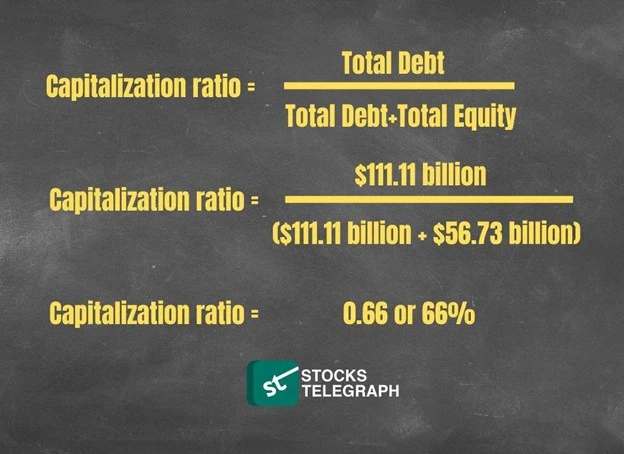
    Let’s calculate the same for Apple Inc (AAPL):

    As of December 31, 2022, Apple’s Total Debt was $111.11 billion and its Total Equity was $56.73 billion, according to its latest quarterly financial statement.

    Total Capitalization Ratio Calculation Example

    Therefore, the capitalization ratio for Apple Inc. as of December 31, 2022, was 0.66. This indicates that a large portion (66%) of the company’s assets is financed through debt rather than equity.

    Limitations of Debt to Capital Ratio

    While the Debt to Capital Ratio is a useful tool for evaluating a company’s financial health and risk, it has several limitations.

    • Having a Partial Picture of the Finances

      Firstly, the debt-to-capital ratio only considers a company’s debt and equity, which may not reflect its entire financial picture. It does not take into account other liabilities such as operating leases or pension obligations.

      These liabilities can have a significant impact on a company’s financial health.

    • No Clue How Much Debt the Company Can Pay Back

      Secondly, the debt-to-capital ratio does not provide any insight into a company’s ability to repay its debt.

      A high debt-to-capital ratio may indicate that a company is taking on too much debt, but it does not reveal whether the company has the means to repay that debt.

    • Accounting Practices Might Affect

      Thirdly, the debt-to-capital ratio can be impacted by a company’s accounting practices. Some companies may use creative accounting techniques to manipulate their debt-to-capital ratio, making it appear more favorable than it actually is.

    • It’s Not a One-Size-Fits-All Thing

      Finally, different industries may have different norms for debt to capital ratio. A high debt-to-capital ratio may be acceptable in one industry but may be a cause for concern in another.

    Total Capitalization vs Market Capitalization

    Total capitalization and market capitalization are both financial metrics used to assess the value and size of a company, but they measure different aspects of a company’s capital structure.

    Total capitalization, also known as the capital structure, represents the total value of a company’s long-term debt and equity financing.

    It encompasses all the sources of capital used by the company, including long-term debt, preferred stock, common equity, and retained earnings.

    Total capitalization provides a comprehensive view of how a company funds its operations and growth.

    Market capitalization, on the other hand, specifically refers to the total value of a company’s outstanding shares of common stock in the open market.

    It is calculated by multiplying the current share price by the total number of outstanding shares.

    Market capitalization reflects the market’s perception of a company’s value and is often used as an indicator of the company’s size and worth in the eyes of investors.

    The main difference between total capitalization and market capitalization is that total capitalization considers all sources of capital, including debt and equity, while market capitalization focuses solely on the value of the company’s common stock.

    Total capitalization provides a broader understanding of a company’s financial structure and risk profile by incorporating all forms of financing.

    Market capitalization, on the other hand, offers insight into how investors perceive the company’s value in the stock market.

    Both metrics have their uses and limitations. Total capitalization helps assess a company’s overall capital structure, financial health, and leverage.

    Market capitalization, on the other hand, can provide insights into a company’s size, relative value, and liquidity in the stock market.

    It is important to consider both total capitalization and market capitalization when analyzing a company, as they provide different perspectives on its financial position and market value.

    Capitalization Ratio vs. Debt to Equity Ratio

    Capitalization ratio and debt-to-equity ratio are two important financial ratios that are used to analyze a company’s financial health and capital structure.

    • How Do They Differ?

      While both ratios provide insights into a company’s capital structure, they differ in the way they measure the relative amounts of debt and equity financing.

    • How Both Ratios Work?

      Capitalization ratio is a measure of a company’s overall debt-to-equity ratio, including both short-term and long-term debt. Debt-to-equity ratio, on the other hand, measures the proportion of a company’s long-term debt to its equity.

    • What Debt-to-Equity Ratio Indicates?

      A higher debt-to-equity ratio indicates that the company is more heavily leveraged and may be at a higher risk of default, while a lower ratio indicates that the company has a stronger financial position.

    • How Important Both Ratios Are?

      Both ratios are important indicators of a company’s financial health and capital structure, but they are used in different ways.

    • What Both Ratios Focus on?

      Capitalization ratio is useful for comparing companies with different levels of debt and equity, while the debt-to-equity ratio is more focused on a company’s long-term debt and equity financing.

    Uses of Total Capitalization

    It is a crucial financial metric that provides valuable insights into the performance and potential of companies and industries.

    Its widespread use in financial analysis and decision-making underscores its importance in the world of finance.

    How Businesses and Investors Use Total Capitalization to Assess the Financial Health of a Company

    One of the primary uses of Total Capitalization is as a benchmark for comparing companies within the same industry.

    Investors use this metric to evaluate the relative size of a company compared to its peers and to determine its potential for growth and profitability.

    A higher value generally indicates a larger and more established company, while a lower value may indicate a smaller, emerging company with greater potential for growth.

    Uses of Total Capitalization - KPI

    • Total Capitalization as a KPI

      It is also used as a key performance indicator (KPI) for investors and financial analysts.

      They use it to track the performance of their investments over time and to make informed decisions about buying or selling stocks.

    • Tracking Market Trends

      The metric can be used to identify trends in the stock market, such as shifts in investor sentiment towards particular industries or sectors.

    • Strategic Decision-Making

      In addition, it is used by companies themselves to make strategic decisions about their capital structure.

      For example, a company may use this metric to determine the optimal mix of debt and equity financing for its operations.

    Comparison of Total Capitalization Across Companies and Industries

    When comparing the total capitalization across companies and industries, it’s important to keep in mind that different industries have different characteristics, such as growth rates, profit margins, and risk levels.

    As a result, some industries may have higher capitalization than others, even if they have fewer companies or smaller companies within the industry.

    For example, the technology industry is known for its high-growth companies and innovative products, which can attract significant investment and lead to higher market capitalization.

    On the other hand, industries such as utilities or consumer staples may have lower growth rates and therefore lower market capitalization.

    Some of the largest companies in the world by market capitalization include Apple, Microsoft, Amazon, and Alphabet (Google) – all of which are technology companies.

    However, there are also large companies in other industries, such as Johnson & Johnson in healthcare, Procter & Gamble in consumer goods, and Berkshire Hathaway in finance.

    Limitations of Using Total Capitalization as a Measure of Financial Health

    While capitalization is a commonly used measure of financial health, there are several limitations to using it as the sole measure of financial health:

    • Ignores the Nature of Capital

      It does not distinguish between debt and equity, which are two different types of capital. Debt is a liability that must be repaid, while equity represents ownership in the company.

      Debt financing may increase a company’s financial risk, while equity financing may dilute the ownership stake of existing shareholders.

    • Does not Account for the Quality of Assets

      It does not take into account the quality of a company’s assets.

      A company with a large amount of debt may appear to have a healthy balance sheet, but if its assets are of poor quality, such as non-performing loans or outdated inventory, the company may still be at risk of financial distress.

    • Ignores the Timing of Cash Flows

      It does not consider the timing of cash flows. A company may have a large amount of capitalization, but if its cash flow is negative, it may be unable to meet its financial obligations when they become due.

    • Does not Reflect Market Conditions

      The measure does not reflect market conditions, which can impact a company’s financial health.

      For example, during an economic recession, the market value of a company’s assets may decline, even if its total capitalization remains unchanged.

    Advantages and Disadvantages of Total Capitalization

    Total capitalization refers to the total amount of capital required to finance a company’s operations, including both equity and debt and has both advantages and disadvantages.

    Advantages of Total Capitalization

    • Flexibility

      A company with total capitalization has the flexibility to choose the most appropriate financing options. It can choose to raise funds through debt or equity, depending on the current market conditions and the company’s financial goals.

    • Improved Creditworthiness

      It can improve a company’s creditworthiness. By having a mix of debt and equity, the company can demonstrate its financial stability, which can make it easier to secure loans and other forms of financing.

    • Reduced Financial Risk

      The metric can help reduce the financial risk of a company. By diversifying its financing sources, the company can avoid relying too heavily on one form of financing, which can be risky if market conditions change.

    • Increased Liquidity

      It can increase a company’s liquidity. By having a mix of debt and equity, the company can have access to a range of financing options, which can help it to raise funds quickly if needed.

    Disadvantages of Total Capitalization

    • Interest Payments

      Companies that use debt to finance their operations will need to make regular interest payments, which can be a significant expense over time.

    • Dilution

      If a company raises funds through equity financing, it may need to issue new shares of stock, which can dilute the ownership of existing shareholders.

      This can result in a reduction in the value of the existing shares.

    • Increased Financial Complexity

      It can increase the financial complexity of a company. Managing multiple sources of financing can be difficult, and it may require the company to hire additional staff or consultants to manage its finances effectively.

    • Risk of Bankruptcy

      Companies that rely heavily on debt financing can be at risk of bankruptcy if they are unable to meet their debt obligations.

      This can lead to a decline in the company’s credit rating and a reduction in the value of its shares.

    Total capitalization can offer many advantages to a company, including flexibility, improved creditworthiness, reduced financial risk, and increased liquidity.

    However, it also has its disadvantages, including interest payments, dilution, increased financial complexity, and the risk of bankruptcy.

    Impact of Total Capitalization on Valuation

    The impact of total capitalization on valuation depends on the context in which it is being evaluated. Generally speaking, a higher value can indicate a larger, more valuable company.

    However, it’s important to keep in mind that the size of a company alone does not necessarily determine its value.

    When valuing a company, investors and analysts typically use a variety of metrics and ratios to evaluate its financial health and potential for growth.

    It is just one of many factors that are considered, and it’s not necessarily the most important one.

    Other factors that can impact valuation include a company’s revenue, earnings, assets, liabilities, and cash flow, as well as its market position, industry trends, and competitive landscape.

    For example, a company with a relatively small value may still be highly valued if it has a strong brand, a loyal customer base, and a track record of profitable growth.

    Conclusion

    Total capitalization represents the total value of a company’s outstanding equity and debt securities, providing a comprehensive view of a company’s overall value.

    The capitalization ratio, also known as the debt-to-equity ratio, measures the proportion of debt and equity that a company uses to finance its operations and investments.

    A high capitalization ratio indicates a company relies heavily on debt to finance its operations, making it vulnerable to financial risks.

    It is an important metric for investors to gain insights into a company’s financial health and long-term viability.

    It provides a more complete picture of a company’s assets and liabilities, evaluating its long-term prospects and investment potential.

    FAQs

    How To Calculate the Long-Term Debt to Total Capitalization Ratio?

    The long-term debt to total capitalization ratio is a financial ratio that indicates the proportion of a company’s long-term debt to its total capitalization (which includes both debt and equity).

    To calculate the long-term debt to total capitalization ratio, determine the total amount of long-term debt on the company’s balance sheet.

    This includes any debt that is due more than one year from the balance sheet date.

    Also, determine the total amount of equity on the company’s balance sheet.

    This includes common stock, preferred stock, and retained earnings. Add the long-term debt and equity together to calculate the company’s total capitalization.

    Divide the long-term debt by the total capitalization to calculate the long-term debt to the total capitalization ratio. The formula for the long-term debt to total capitalization ratio is:

    Long-term debt / (Long-term debt + Equity) = Long-term debt to total capitalization ratio

    How Can Investors Use Total Capitalization in Their Analysis Of A Company?

    Investors can use total capitalization to evaluate a company’s overall worth and to compare it with other companies in the same industry.

    By analyzing a company’s total capitalization, investors can also get an idea of how much risk they are taking on by investing in that company.

    A higher total capitalization may indicate that the company has a solid financial foundation and a lower risk of bankruptcy or failure, while a lower total capitalization may indicate a higher level of risk.

    How Is Total Capitalization Different from Market Capitalization?

    Total capitalization and market capitalization are both financial metrics used to measure the value of a company, but they differ in their scope and calculation method.

    The key difference between the two metrics is that total capitalization includes debt financing, while market capitalization does not.

    As a result, market capitalization tends to be a more commonly used metric as it focuses solely on equity financing and gives a clearer picture of a company’s perceived value by investors.

    What Is a Good Long-Term Debt-To-Total Capitalization Ratio?

    A lower long-term debt to total-capitalization ratio is generally considered more favorable, indicating a smaller reliance on debt financing and a healthier financial structure.

    However, the definition of a “good” ratio varies depending on the industry, company size, and specific financial goals.

    What Is the Total Capitalization Formula?

    The total capitalization formula calculates the total value of a company’s capital structure, which includes both debt and equity. The total capitalization formula is as follows:

    Total Capitalization = Debt + Equity

    Debt refers to the total outstanding debt obligations of the company, such as loans, bonds, and other forms of borrowed funds. Equity represents the total value of the company’s ownership interests, including common stock, preferred stock, and retained earnings.

    By summing up the debt and equity components, total capitalization provides an overview of the financial structure and valuation of a company.