Tag: what is equity

  • Unlock the Value of Business Equity: A Comprehensive Guide

    Unlock the Value of Business Equity: A Comprehensive Guide

    Unlocking the value of business equity can be the key to taking your company to the next level. However, with so many options available, it can be difficult to know where to start. That’s why our comprehensive guide is here to help.

    From equity financing to mergers and acquisitions, we’ll explore the different strategies you can use to unlock the full potential of your business equity.

    Expert insight and practical advice will help you determine your company’s value, attract investors, and negotiate deals that are beneficial to all parties.

    No matter where you are in your business journey, this guide is an invaluable resource for anyone looking to grow their business.

    What Is Equity?

    Equity is a fundamental concept in business and finance that represents the ownership interest in a company. In other words, business equity represents the residual value of a company’s assets after all liabilities have been paid off.
    It can be thought of as the amount of a company’s assets that belong to the owners, shareholders, or investors.

    Equity can be raised in various ways, such as through the sale of shares of stock, retained earnings, or by issuing convertible securities. A shareholder’s investment results in ownership of the company and potential returns, including dividends and capital gains.

    It is a crucial component of a company’s capital structure and can be used to finance growth and expansion, as well as to attract new investors.

    With equity financing, companies can fund projects they would not have been able to invest in with debt financing since no interest is charged. However, equity financing comes with risks, as shareholders bear the brunt of losses and liabilities associated with the company.

    How Shareholder Equity Works

    Shareholder equity is an important indicator of a company’s financial health and is a crucial component of its balance sheet. In addition to serving as an instrument for attracting new investors, it represents the value of the company owned by its shareholders.

    There are several ways that shareholder equity can increase. A company that generates profits can, for instance, reinvest the profits or distribute them to shareholders as dividends. Furthermore, if a company’s assets increase in value, shareholder equity can rise as well.

    However, shareholder equity can also decrease. For example, if a company incurs losses, this can decrease its shareholder equity. Additionally, if a company takes on debt or issues new shares of stock, this can dilute the value of existing shares and decrease shareholder equity.

    Formula and How to Calculate Shareholders’ Equity

    The formula for calculating shareholders’ equity is relatively simple. It is calculated by subtracting a company’s total liabilities from its total assets. The resulting figure represents the total value of the company that is owned by its shareholders.

    Here’s the formula for shareholders’ Equity:

    Business Equity - Formula and How to Calculate Shareholders' Equity

    Total assets include all of a company’s assets, such as cash, inventory, property, and equipment. Total liabilities include all of a company’s debts and obligations, such as loans, accounts payable, and taxes owed.

    What the Components of Shareholder Equity Are?

    • What is Common Equity?

      Common equity is also called Common stock represents the ownership of a company’s shares by its investors. It is the most common form of equity and typically provides investors with voting rights and the potential to receive dividends.

    • Retained Earnings

      Retained earnings are the profits that a company has earned and kept, rather than distributing to its shareholders as dividends.

      These earnings can be used to reinvest in the company’s growth and expansion, which can increase the value of the company and, in turn, the value of its shareholders’ equity.

    • Additional Paid-in Capital

      Additional paid-in capital is the amount of money that investors have paid for shares of stock that is in excess of the par value of the shares. This component of shareholder equity can be the result of a company issuing new shares of stock or through the sale of preferred stock.

    Owners and Business Equity

    Owners are the individuals or entities who have a claim to the equity in a business. This can include individual investors, venture capitalists, private equity firms, and even the company’s own management team.

    Owners have a direct stake in the success or failure of the business, as their equity represents their ownership interest in the company. They can participate in the decision-making process and potentially receive returns on their investment in the form of dividends or capital gains.

    Equity Balance Sheet for a Single Owner

    Here is an example of an equity balance sheet for a single owner:

    Business Equity - equity balance sheet

    In this example, the owner has assets worth $100,000 and liabilities of $50,000, resulting in equity of $50,000. This represents the residual value of the owner’s assets after all liabilities have been paid off.

    The equity balance sheet is an important financial document that helps to track the value of a business over time. It provides an overview of the company’s financial health and can be used to assess its potential for growth and profitability.

    Equity Balance Sheet for Multiple Owners

    Here is an example of an equity balance sheet for a business with multiple owners:

    Business Equity - balance sheet for multiples owners

    In this example, the business has three owners, and their individual equity values are combined to create the total equity value for the business. The equity value represents the residual value of the business’s assets after all liabilities have been paid off.

    Example of Shareholder Equity

    Here is an example of shareholder equity for a fictional company:

    Business Equity - shareholder equity for a fictional company

    In this example, the shareholder equity of the company is $175,000. This is made up of $50,000 in common stock, $100,000 in retained earnings, and $25,000 in additional paid-in capital. This provides an overview of the value of the company that belongs to its shareholders.

    Other Forms of Equity

    In addition to shareholder equity, there are other forms of equity that can exist within a business or financial context.

    One such form is owner’s equity, which is the equity value that belongs to the owner or owners of a business. This equity can be in the form of investments made by the owner, as well as any profits earned by the business that are not distributed to shareholders as dividends.

    Another form of equity is real estate equity, which represents the value of a property that is owned outright by an individual or entity. This equity can increase over time as the property appreciates in value or through the accumulation of equity through mortgage payments.

    In the context of personal finance, home equity can also refer to the value of a homeowner’s property that exceeds any outstanding mortgage or other debts secured by the property. This equity can be used as collateral for loans or lines of credit.

    Private Equity

    Private equity refers to investments made in private companies that are not publicly traded on stock exchanges. Private equity firms typically invest large amounts of money in companies that they believe have strong growth potential, with the aim of eventually selling their stake in the company for a profit.

    Private equity firms raise funds from institutional investors such as pension funds, insurance companies, and high-net-worth individuals, and then use that money to invest in private companies.

    The investments are typically made through a combination of debt and equity financing, and the private equity firm often takes an active role in managing the company.

    Private equity investments can be high-risk, high-reward opportunities. The companies that receive private equity investments may be in the early stages of development or undergoing significant changes, which can make their future prospects uncertain.

    However, if the investment is successful, the private equity firm can earn a significant return on its investment.

    Private equity is a significant force in the financial industry, with billions of dollars invested in companies around the world. It can provide funding and support for companies that might otherwise struggle to secure financing and can help drive innovation and growth in industries across the economy.

    Types of Private Equity Financing

    Private equity financing refers to investments made by private equity firms into private companies, typically with the goal of providing capital to fuel growth, improve operations, and ultimately generate a return on investment. There are several types of private equity financing, including:

    • Leveraged Buyouts (LBOs)

      This is a type of private equity financing where a private equity firm acquires a controlling stake in a company using a significant amount of debt financing. The goal is to use the cash flow generated by the acquired company to pay off the debt over time.

    • Growth Capital

      This is a type of private equity financing that provides capital to a company to fund expansion or other strategic initiatives, such as product development, marketing, or acquisitions.

    • Mezzanine Financing

      This is a type of financing that sits between debt and equity financing and is typically used to fund the expansion of a company. Mezzanine financing is characterized by higher interest rates and fewer restrictions on the borrower than traditional debt financing.

    • Distressed Debt Investing

      This is a type of private equity financing where an investor purchases the debt of a company that is in financial distress, with the goal of taking over the company and turning it around.

    • Venture Capital

      This is a type of private equity financing that provides capital to start-up or early-stage companies that have the potential for high growth. Venture capital firms typically invest in companies that are still in the development stage and have yet to generate significant revenue.

    • Angel Investing

      This is a type of private equity financing where individual investors provide capital to start-up or early-stage companies in exchange for equity in the company. Angel investors typically invest small amounts of money than venture capital firms and are often more involved in the management of the company.

    Home Equity

    Home equity refers to the portion of a property’s value that is owned outright by the homeowner, and is not owed to any mortgage or other lender.

    Home equity can be used in a number of ways, including as collateral for a loan or line of credit, or as a source of funds for large expenses such as home renovations or college tuition.

    One way to access home equity is through a home equity loan, which allows homeowners to borrow a fixed amount of money using their home as collateral. Home equity loans typically have fixed interest rates and monthly payments, and can be a good option for homeowners who need a lump sum of cash for a specific expense.

    Another option is a home equity line of credit (HELOC), which allows homeowners to borrow against their home equity on an as-needed basis. HELOCs typically have variable interest rates, and homeowners can draw on the line of credit as needed up to a certain limit.

    Brand Equity

    Brand equity refers to the value that a brand adds to a company and its products or services. It represents the intangible assets that a brand holds, such as consumer perception, brand awareness, and loyalty.

    Strong brand equity can help a company differentiate its products or services from competitors and command a premium price.

    One of the key components of brand equity is brand awareness, or the extent to which consumers are familiar with a brand and its products or services. This can be achieved through effective marketing and advertising campaigns that promote the brand and its unique features and benefits.

    Another important aspect of brand equity is brand loyalty, or the degree to which customers are committed to a particular brand and choose it over others. This can be fostered through positive customer experiences, consistent messaging and branding, and a strong reputation in the industry.

    Equity vs. Return on Equity

    Equity and return on equity are two related but distinct financial metrics.

    Equity refers to the total value of assets that a company owns outright, minus any liabilities or debts that it owes. This represents the portion of a company’s value that is owned by its shareholders.

    Return on equity (ROE), on the other hand, is a measure of how efficiently a company is using its equity to generate profits. It is calculated by dividing a company’s net income by its total equity.

    While equity represents the total value of a company’s assets, ROE provides insight into how effectively the company is using those assets to generate profits for its shareholders.

    A high ROE indicates that a company is using its equity efficiently and generating strong returns for its shareholders, while a low ROE may suggest that the company is not maximizing the potential of its assets.

    Concluding Remarks

    In conclusion, unlocking the value of business equity is a complex process that requires careful consideration and planning.

    However, by following the comprehensive guide outlined in this article, business owners can gain a better understanding of their options and develop a strategy to maximize the value of their equity.

    Whether it’s through selling the business, restructuring ownership, or accessing capital through equity financing, there are a variety of methods available to business owners to unlock the full potential of their equity.

    By taking a proactive approach and seeking professional advice when necessary, business owners can successfully unlock the value of their equity and achieve their financial goals.


  • Total Equity: Know its Significance in Investment Decisions

    Total Equity: Know its Significance in Investment Decisions

    A company’s true worth can’t be measured by its assets alone; that’s where total equity comes in.

    This critical financial metric gives investors a clear picture of a company’s net worth after all debts and liabilities are accounted for.

    Also known as Shareholder’s equity, it is a crucial factor for investors in evaluating a company’s financial strength and stability.

    It is an important measure for making investment decisions as it indicates the value of the assets that are owned by a company, minus its liabilities.

    This information is important because it reflects the financial health of the company and its ability to generate future earnings.

    Investors use total equity as one of the indicators to evaluate a company’s worth and make investment decisions.

    A higher equity value generally implies that the company has more assets than liabilities, indicating that it has the ability to handle short-term and long-term financial obligations.

    It also indicates that the company has a strong financial foundation, which is attractive to potential investors and can help to secure future funding.

    Moreover, the equity value can provide insights into the company’s dividend-paying capacity, which is an important consideration for investors seeking regular returns.

    If a company has a high equity value, it can use its earnings to pay dividends, which is attractive to investors looking for steady income.

    What is Total Equity?

    Total equity is a financial metric that represents the total value of ownership interest in a company.

    In other words, it represents the residual value of a company’s assets that would be left over for shareholders if all the company’s debts were paid off.

    To illustrate this, let’s consider the example of Apple Inc. As of the end of its Dec 2022 quarter, Apple’s balance sheet reported equity of $56.73 billion.

    This represents the amount of value that the company’s owners or shareholders have in the business.

    Total equity is calculated as the sum of a company’s retained earnings, which is the portion of net income that is not paid out as dividends, and its capital stock or other forms of contributed capital.

    In the case of Apple, its shareholder’s equity is composed of $3.24 billion in retained earnings and $53.24 billion in common stock, and additional paid-in capital.

    Importance of Equity Income Funds

    Equity income funds are important because they provide investors with a source of regular income while also allowing them to participate in the potential long-term growth of the stock market.

    • What are Equity Income Funds?

      Equity income funds are mutual funds or exchange-traded funds (ETFs) that invest in stocks of companies with a history of paying high dividends.

      These funds aim to provide investors with regular income through dividend payouts while also seeking long-term capital appreciation through stock price appreciation.

    • How Equity Income Funds Work: An Example

      Let’s say you invest $10,000 in an equity income fund. The fund manager uses that money to purchase stocks of companies that have a history of paying high dividends.

      These companies could be from various sectors such as utilities, consumer staples, energy, or real estate.

      Over time, as the companies generate profits, they may decide to distribute some of those profits as dividends to their shareholders.

      When this happens, the equity income fund collects those dividends and distributes them to its investors.

      For example, let’s say the equity income fund you invested in holds shares of Company XYZ, which pays a quarterly dividend of $0.50 per share.

      If the fund holds 1,000 shares of Company XYZ, it would receive $500 in dividend income every quarter.

    • Benefits of Investing in Equity Income Funds

      The fund manager would then distribute a portion of that dividend income to you as an investor in the fund.

      By providing regular income through dividend payouts, equity income funds also seek long-term capital appreciation.

      As the companies held by the fund grow and their stock prices rise, the value of your investment in the fund can increase over time.

      Additionally, equity income funds can provide diversification benefits as they invest across a range of industries and companies, reducing the impact of a single stock’s performance on the overall portfolio.

    Other Forms of Equity

    • Private Equity

      Private equity refers to investments made in privately held companies that are not traded on public stock exchanges.

      Private equity firms pool funds from investors to acquire equity stakes in private companies, to generate returns through various strategies such as leveraged buyouts, venture capital investments, and growth capital.

    Types of Private Equity Financing

    There are various types of private equity financing, including venture capital, which provides funding to early-stage companies with high growth potential; leveraged buyouts, where a company is acquired using a significant amount of debt; growth equity.

    That supports established companies in their expansion efforts; and mezzanine financing, which combines elements of debt and equity to provide capital for specific projects or acquisitions.

    • Home Equity

      Home equity refers to the value of ownership that a homeowner has built up in their property.

      It is the difference between the market value of the home and the outstanding mortgage balance.

      Homeowners can access their home equity through home equity loans or home equity lines of credit, which allow them to borrow against the value of their property.

    • Brand Equity

      Brand equity represents the intangible value and perception associated with a brand.

      It encompasses factors such as brand awareness, customer loyalty, perceived quality, and brand reputation.

      Building and maintaining strong brand equity is important as it can lead to increased customer preference, trust, and financial value for the brand.

      Companies invest in marketing, advertising, and customer experience strategies to enhance their brand equity.

    How Total Equity Works

    Total equity can increase in several ways, such as when a company earns profits.

    • By Retaining Earnings

      When a company earns profits, it increases its retained earnings, which is a component of shareholder equity.

      Retained earnings are the portion of a company’s profits that are not distributed as dividends to shareholders but are kept within the company for future use.

    • Issuance of New Shares

      Issuing new shares of stock is another way to increase shareholder equity.

      When a company issues new shares of stock, it raises additional capital that can be used to invest in the company’s growth, pay off debts, or distribute as dividends.

      The new shares are sold to investors, which increases the number of outstanding shares and the amount of shareholder equity.

    • With The Increase in Assets Value

      Another way shareholder equity can increase is when the value of a company’s assets increases.

      The value of a company’s assets can increase due to factors such as appreciation in the value of property, plant, and equipment, or an increase in the value of investment securities.

    • Adverse Effect On Total Equity

      • Issuance of Shares

        Conversely, shareholder equity can decrease when a company incurs losses. When a company incurs losses, its retained earnings decrease, which results in a decrease in shareholder equity.

      • Repurchasing of Shares

        Repurchasing its own shares and paying dividends to shareholders also reduce shareholder equity.

        When a company repurchases its own shares, it reduces the number of outstanding shares, which in turn reduces the amount of shareholder equity.

      • Paying Dividends

        Similarly, paying dividends to shareholders reduces the amount of retained earnings and thus decreases shareholder equity.

    • Asset Value Decline

      Lastly, the value of a company’s assets can decrease, which also results in a decrease in shareholder equity.

      This can happen due to factors such as the depreciation of property, plant, and equipment or a decline in the value of investment securities.

      Overall, several factors can influence changes in shareholder equity, and it is important for investors to monitor these changes to assess the financial health of a company.

    Total Equity: Formula and How to Calculate Shareholders’ Equity

    The formula to calculate Shareholders’ Equity is:

    Total equity: Formula and How to Calculate Shareholders' Equity

    This formula is based on the fundamental accounting equation, which states that a company’s assets must equal the sum of its liabilities and equity.

    Shareholders’ Equity represents the amount of capital that the company’s owners have invested in the business, as well as any profits that have been retained within the company.

    How to Calculate Total Equity and Liabilities?

    To calculate the total liabilities and equity of a company, you need to compile the necessary financial information from the company’s balance sheet. Here’s the formula:

    How to Calculate Total Equity and Liabilities

    1. Start with the company’s balance sheet, which provides a snapshot of its financial position.
    2. Locate the section for liabilities, which includes both current and long-term liabilities.
    3. Current liabilities typically include short-term debts, accounts payable, and accrued expenses. Long-term liabilities encompass items like long-term debt, bonds payable, and deferred taxes.
    4. Add up all the current liabilities and long-term liabilities to obtain the total liabilities.
    5. Move on to the section for equity, which includes shareholders’ equity and retained earnings.
    6. Shareholders’ equity may consist of common stock, preferred stock, additional paid-in capital, and any other equity accounts. Retained earnings represent the accumulated profits or losses of the company over time.
    7. Sum up the shareholders’ equity and retained earnings to calculate the total equity.
    8. Finally, add the total liabilities and total equity together to determine the total liabilities and equity of the company.

    What is a Total Equity on a Balance Sheet?

    Total equity, also known as shareholder’s equity or net worth, is a key component of a company’s balance sheet.

    It represents the residual interest in the assets of the company after deducting liabilities. In other words, it is the ownership claim on the company’s assets.

    Total equity is calculated by subtracting total liabilities from total assets:

    Total Equity = Total Assets – Total Liabilities

    The components of total equity typically include:

    • Shareholders’ Capital

      This includes the amount of money contributed by shareholders through the issuance of common stock, preferred stock, or additional paid-in capital.

    • Retained Earnings

      Retained earnings are accumulated profits or losses that have not been distributed to shareholders as dividends.

      It represents the company’s accumulated net income over time.

    • Treasury Stock

      If the company has repurchased its own stock, the value of treasury stock is deducted from total equity.

    • Other Comprehensive Income

      This includes items such as unrealized gains or losses from changes in the value of certain investments or foreign currency translation adjustments.

    How to Find Average Total Equity?

    To find the average total equity, you need to gather the opening and closing values of total equity for a specific period and calculate the average using the following total equity formula:

    Average Total Equity = (Opening Total Equity + Closing Total Equity) / 2

    Here’s a step-by-step guide:

    1. Determine the period for which you want to calculate the average total equity (e.g., a quarter, a year, etc.).
    2. Obtain the opening total equity value for the start of the period from the company’s balance sheet or financial statements.
    3. Retrieve the closing total equity value for the end of the period from the company’s balance sheet or financial statements.
    4. Add the opening total equity and the closing total equity together.
    5. Divide the sum by 2 to calculate the average total equity.

    The average total equity formula provides a representative value that can be useful for analysis and comparisons over a specific period.

    It helps assess the stability and growth of a company’s equity position over time.

    Components of Shareholder Equity

    The components of shareholder equity typically include:

    • Paid-in Capital

      This is the amount of capital contributed by shareholders when they purchased the company’s shares.

    • Retained Earnings

      This represents the cumulative profits earned by the company that has not been distributed to shareholders as dividends.

    • Treasury Stock

      This is the portion of the company’s own shares that have been repurchased and are held in treasury.

    • Accumulated Other Comprehensive Income

      This includes gains and losses that are not included in net income, such as changes in the value of certain investments or foreign currency translation adjustments.

    • Noncontrolling Interest

      This represents the portion of a subsidiary’s equity that is not owned by the parent company.

      These components can vary depending on the company’s structure and accounting practices.

      However, a higher total equity typically indicates a stronger financial position and may be seen as a positive indicator for investors.

    Example of Shareholder Equity

    An example of a major company with shareholder equity is Apple Inc.

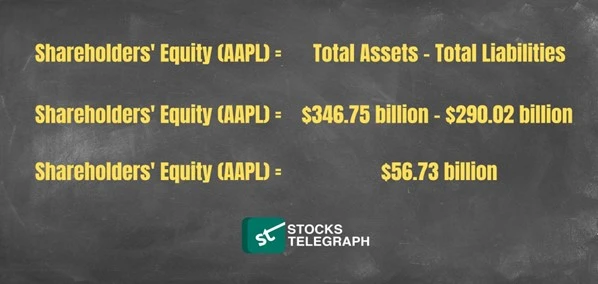
    As of its most recent financial statement for Q4 2022, Apple’s shareholder equity was reported to be $56.73 billion with total assets of $346.75 billion and total liabilities of $290.02 billion.

    Total equity: Example of Shareholder Equity

    What Are Some Other Terms Used to Describe Equity?

    Equity, in the context of finance and accounting, is often referred to by different terms that highlight specific aspects or perspectives of the concept.

    Here are some other terms commonly used to describe equity:

    • Shareholders’ Equity

      This term emphasizes the ownership interest of shareholders in a company. It represents the residual claim on the company’s assets after deducting liabilities.

    • Net Assets

      Net assets represent the value of a company’s total assets minus its total liabilities. It reflects the net worth or equity of the company.

    • Book Value

      Book value refers to the value of a company’s assets minus its liabilities, as recorded in the company’s accounting books.

      It represents the net value of the company according to its financial statements.

    • Owners’ Equity

      This term underscores the ownership stake of the individuals or entities that have invested in a business.

      It represents the equity position held by the owners of the company.

    • Capital

      Capital refers to the financial resources invested in a company by its owners or shareholders.

      It can be in the form of cash, assets, or contributions made by investors.

    • Equity Stake

      Equity stake refers to the percentage or proportion of ownership that an individual or entity holds in a company.

      It indicates the extent of their equity interest in the business.

      These terms are used interchangeably to describe the concept of equity, each emphasizing different perspectives related to ownership, value, and financial position within a company.

    Conclusion

    Also known as Owner’s Equity, Total equity represents the net assets of a company, calculated as the difference between its total assets and total liabilities.

    It’s the portion of a company’s capital that belongs to its owners or shareholders. It is an important metric for investors to evaluate the financial health and potential of a company.

    It provides insights into a company’s ability to generate future earnings, handle financial obligations, and pay dividends, which are all critical factors in making informed investment decisions.

    FAQs

    What Does Total Equity Mean in Business?

    Total equity in a business refers to the portion of a company’s assets that belong to its owners or shareholders. It is calculated by subtracting a company’s liabilities from its total assets.

    In other words, total equity represents the residual value of a company’s assets after its debts and other obligations have been paid off.

    This amount can be used to measure a company’s financial health, as well as its ability to generate future profits and dividends for its shareholders.

    Is Higher Total Equity Good?

    Higher total equity can be good for a company because it represents the number of assets that the company owns outright without any liabilities or debts.

    This can indicate financial stability and the ability to weather economic downturns or unexpected expenses.

    However, a very high equity level may also mean that the company is not taking advantage of opportunities to invest in growth or expansion, which could limit its long-term potential for profitability.

    Ultimately, the optimal level of equity will depend on the specific circumstances of the company and its goals.

    What Does It Mean to Have 100% Equity?

    Having 100% equity means that all of the assets in a portfolio are invested in stocks or other equity securities. This means there are no investments in fixed income or other asset classes, such as bonds or cash.

    What Are the Three Types of Equity?

    The Three Basic Types of Equity

    1. Common Stock: Common stock represents ownership in a corporation.
    2. Preferred Shares: These are stock in a company that has a defined dividend, and a prior claim on income to the common stockholder.
    3. Warrants: These are a form of option usually added to a corporate bond issue or preferred stock in order to sweeten the deal.

    What Are The 4 Parts of Equity?

    1. Outstanding Shares
    2. Paid-In Capital
    3. Retained Earnings
    4. Treasury Stocks