Tag: cryptocurrencies

  • Binance’s New Product Under Scrutiny

    Binance’s New Product Under Scrutiny

    The leading cryptocurrency exchange Binance had recently launched a new product – tradable stock tokens. The tradable stock tokens are aimed to enable users to benefit from returns on equities without having to purchase full shares. The first stock token to be publically traded is Tesla. Through the stock, token users can purchase as little has one-hundredth of Tesla’s stock which will be represented by a digital token. The stock price will be settled in a stablecoin, Binance USD (BUSD), and will not be tradeable for shares.

    Regulation in the cryptocurrency sphere has been a widely debated topic and with the rise of the crypto market governments are realizing regulation needs to be taken seriously while preserving an environment that harbors innovation and cooperation as well.

    The new tradeable stock token of Binance has not gone unnoticed by regulators. European and British regulators are debating over the tradeable stock token’s compliance with securities laws. Germany’s Federal Financial Supervisory Authority, BaFin, is worried that the tokenized stock may not be able to provide the required transparency. There is ambiguity regarding the nature of the stock tokens and it is unclear whether they are securities or not.

    The tradeable stock was designed in partnership with the regulated investment group CM-Equity AG. Binance has argued that the tokens are official products of CM-Equity AG which makes them fully compliant with European as well as German regulations. The cryptocurrency exchange further argues that since the stocks are settled in Binance USD and not fiat currency, they do not give the same rights as traditional stocks.

  • UK Banks Not Fans of Cryptocurrencies

    UK Banks Not Fans of Cryptocurrencies

    Where on one hand the cryptocurrency market is soaring and institutions are realizing the potential that the blockchain technology holds, on the other hand there has also been an increase in the growing skepticism.

    The cryptocurrency adoption has seen some major developments. From major financial institutions like Goldman Sachs providing cryptocurrency exposure to clients to corporate behemoths like Tesla accepting cryptocurrency payments, the cryptocurrency industry has come a long way. But amidst all that, it cannot be ignored that cryptocurrencies have a notorious reputation for being the hotbed for illegal activities.

    A major UK bank, NatWest, has issued a statement stating the bank will refuse service to customer who deal in cryptocurrencies. Morten Friis, head of the bank’s risk committee, revealed in a recent shareholder meeting the bank has no interest in dealing with clients whose businesses are backed by cryptocurrency exchanges or cryptocurrency trading and investing is their primary activity.

    The bank’s decision stems from the notorious reputation of cryptocurrencies as well as crypto regulation. The regulation of the cryptocurrency is also a sore topic for many and entails unnecessary complications for anyone looking to get involved in the crypto sphere.

    This is not the first time UK banks have had such a strong stance on cryptocurrencies. Another UK bank HSBC also has a strong anti-crypto narrative. The bank has barred its users from investing in MicroStrategy – the business intelligence company with major cryptocurrency investments. HSBC had also denied users to deposit profits from cryptocurrency exchanges.

    The UK banks anti-crypto stance will also have consequences for the cryptocurrency adoption as corporate clients like Tesla that are moving towards accepting cryptocurrency payments will also now face difficulties.

  • Is It Time For Bitcoin To Move To Proof-of-Stake Mechanism?

    Is It Time For Bitcoin To Move To Proof-of-Stake Mechanism?

    Ripple co-founder Chris Larsen certainly thinks so. In a blogpost, Larsen detailed about the shortcomings of the proof of work mechanism. Bitcoin is the market leader but the high transaction costs as well as the energy costs may prove to be a hindrance in its way of maintaining its rank which is why the co-founder suggests it is high time Bitcoin shift from a proof of work mechanism to a proof of stake mechanism.

    Larsen furthered that newer cryptocurrencies are moving away from the energy-intensive proof of work mechanism as well as older cryptocurrencies. Ethereum, the queen of the market, in its much-anticipated eth2.0 upgrade has also designed a move from proof of work to proof of stake. Per the co-founder, altcoins utilizing proof of stake mechanism now comprise 43% of the market – including Ethereum. But where miners and other stakeholders are vowing to utilize green sources of energy, there needs to be renewed efforts to move the crypto industry towards sustainable energy or sustainable mechanisms.

    Ripple Labs has not been a fan of Bitcoin because of its increasing carbon footprint. Brad Garlinghouse, CEO of Ripple Labs, have also been actively speaking out against the environmental costs of cryptocurrency mining – especially Bitcoin since it is done at such a massive scale. Garlinghouse had stated that one transaction on the Bitcoin block chain is equal to the environmental impact of 75 gallons of gasoline burned.

    As the cryptocurrency industry moves towards mass-scale adoption, the environmental impact of mining cannot be ignored. With the proof of work mechanism more energy intensive than the proof of stake, a shift to the more efficient technology will become imminent.

  • Rampant Increase In Crypto Scams – Is ASIC’s stance too weak?

    Rampant Increase In Crypto Scams – Is ASIC’s stance too weak?

    Australian Securities and Investment Commission (ASIC) has been vocal about promoting and supporting the cryptocurrency industry in the country but regulating the crypto sphere is a tricky business and along with most governments throughout the world, the Australians are struggling too.

    Previously, at the Australian Blockchain Conference, senior advisor of strategic intelligence at ASIC – Jonathan Hatch –appealed for collaboration from the crypto industry. Hatch also pointed out towards some of the efforts of ASIC to build trust and harbor innovation in the country. However, Hatch did not receive positive feedback from the crypto industry as most crypto firms regarded ASIC’s cryptocurrency regulation as vague and unclear.

    ASIC commissioner Cathie Armour – speaking today during the Australian Blockchain Conference – furthered the stance of ASIC on the crypto industry. Armour stated that ASIC is working towards improving the financial ecosystem in the country all the while ensuring that stakeholders have confidence in the system. The commissioner was also keen on the idea of incorporating various blockchain products in order to achieve ASIC’s goal. Armour specifically mentioned the distributed ledger technology (DLT) and its potential. ASIC is planning to integrate DLT into its clearing system.

    However, a much as the Australian regulator is keen on supporting the crypto industry strict regulation is also crucial in order to protect consumers. There has been a rampant increase in the number of crypto scams reported. Dating sites and apps have become a hotbed for crypto-asset scams. While last year, during the pandemic the regulator recorded a 20% increase in scam activity. It is now high time the regulator needs to evaluate the existing crypto regulation and whether or not they are doing enough to ensure safety.

  • XRP Assets Under Management Doubles in Value

    XRP Assets Under Management Doubles in Value

    As the market for Bitcoin turned bearish, investors have started flocking towards altcoins. Ripple has had a rocky journey ever since the bull run started as Ripple Labs found itself tangled in litigation. However, as the defense appears to be performing well currently in the Ripple Labs v. US Securities & Exchange Commission lawsuit, the cryptocurrency has begun moving upwards.

    Recently a discovery motion was submitted by the legal team of Ripple Labs to gain access to SEC’s documentation on Bitcoin and Ethereum in order to refute the claim of SEC that Ripple is fundamentally different than other cryptocurrencies. The victory along with the denial of access to Ripple executives’ financial records has put the cryptocurrency back on track.

    XRP saw a huge rally of investors the past week. CoinShares Weekly digital asset fund flow report revealed that around $33 million were injected into XRP products the past week. This makes the total asset under management of XRP almost double to a total of $83 million.

    Most of the altcoins observed huge investment inflows according to the report. Around $65 million were injected into Ethereum products, $3 million into Binance Coin, $4 million to Bitcoin Cash while Polkadot saw $5 million in investment and Tezos $7 million. Although Bitcoin products still hold a majority of assets under management at $50 billion – which is nearly 78% of the total AUM – but the bearish momentum of Bitcoin may divert the attention to altcoins.

    Institutional interest in the crypto sphere, in general, has been increasing. From a time when institutions like Goldman Sachs regarded cryptocurrencies to have mere speculative to investing heavily into them. Goldman Sachs along with other leading banks have announced to offer cryptocurrencies because of high client demand.

  • Uniswap – One Step Closer to V3

    Uniswap – One Step Closer to V3

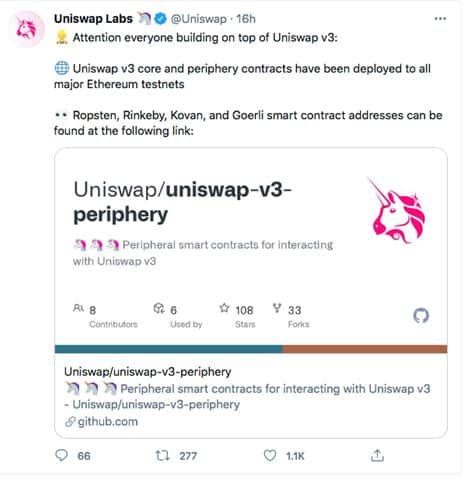
    The leading decentralized exchange, Uniswap, has moved a step closer to its third iteration as it has announced the successful deployment of V3 smart contracts to Ethereum’stestnets. The smart contracts are now on Ethereum’stestnets – Ropsten, Rinkeby, Kovan, Goerli – and the testnet addresses have been posted on GitHub. Amidst the developments of Uniswap V3, the DEX has also reported a record high weekly trading volume of $10 billion.

    Uniswap V3 is the newest iteration of the Uniswap protocol. The iteration is designed to provide better capital efficiency for users and greater capital control for lenders. This will be done through the two hallmark features of the iteration – concentrated liquidity and multiple fee tiers. The result will be the most efficient and flexible AMM ever made, according to Uniswap’s team.

    Uniswap has a high valuation and dominance in the Automated Market Maker sphere but the new iteration will further boost the DEX. Previously, the announcement of the V3 had led to a surge in the price of the native token of the governance. The launch of the V3 iteration will probably result in another price surge of the native token, UNI.

    The iteration is set to launch on May 5.

  • The TIMEs are Changing for the Crypto Sphere

    The TIMEs are Changing for the Crypto Sphere

    TIME Magazine, one of the most circulated bi-weekly magazines in the US, is exploring the cryptocurrency sphere and its integration into blockchain technology. The magazine recently announced it is going to start accepting payments in cryptocurrencies. The magazine entered into a partnership with the digital asset exchange Crypto.com which now allows readers of the magazine to pay for subscriptions through digital assets.

    The current bull run made it evident that cryptocurrencies are not mere speculative investments and blockchain technology holds a lot of potentials. This has led to various firms jumping in to explore the real-world use cases of blockchain technology while others have begun adopting cryptocurrencies.

    TIME magazine recently sold three magazine covers as NFTs. However, For TIME magazine, the journey does not end over here. The magazine is extensively exploring non-fungible tokens and projects based around them. In an interview with Decrypt podcast, TIME magazine president Keith Grossman commented on the NFT sale that this is just the beginning of the journey.

    Grossman stated that the magazine may soon shift from the NFT collectibles to NFTs for subscriptions and memberships. While other news outlets like The New York Times have also entered the NFT collectibles space, TIME is the first magazine to accept payments in cryptocurrencies and may soon integrate the NFT technology completely.

  • Dogecoin: Snack Brands Favorite Coin

    Dogecoin: Snack Brands Favorite Coin

    Dogecoin (DOGE) the meme-based coin started off as a joke between two engineers but the crypto is no longer any joke. Dogecoin has been one of the best performing cryptocurrencies in the bull run as it climbed up to establish a record high. One of the most vocal support of DOGE is Elon Musk – the tech billionaire and CEO of Tesla. Musk often sends the coin up soaring with his tweets but Musk is not the only one who supports Dogecoin.

    DOGE has become a brands’ favorite. The US-based meat snack company Slim Jim has started actively promoting Dogecoin. The brand often tweets memes featuring DOGE and meat snacks going up to the moon. It may have become a new marketing technique as the brand increased its following on Twitter five-folds by supporting Dogecoin. Slim Jim has also launched an NFT up for sale which features DOGE represented by Shiba Inu to the moon. The brand has said to donate 100% of the proceedings from the NFT to charity along with an additional $10,000.

    Milkyway and Snickers by Mars confectionary company have also been vocal supporters of Dogecoin on their social media. The brands have been actively advocating and supporting cryptocurrency with various memes.

    The active support from snack brands of Dogecoin has also faced lashback as some people regard Dogecoin to have no intrinsic value. After establishing an all-time high at $0.43, DOGE has fallen more than 20% in the past 24 hours. Are the glory days of the coin over?

  • South Korea’s Tightening Grip On Crypto Market In The Country

    South Korea’s Tightening Grip On Crypto Market In The Country

    Among other things, cryptocurrencies are also notoriously known for facilitating illegal transactions. Because of the anonymity provided by privacy coins, they are likely to become the choice for illegal activities. However, another side of the story states data suggests most illegal transactions still happen through cash. Nonetheless, Asian governments have been wary of cryptocurrencies because of their high riskiness as well as their propensity to facilitate illegal activities.

    The government of South Korea had been vocal about their concerns with the cryptocurrency market in the country. The regulators have taken notice of the use of cryptocurrencies in money laundering, tax evasion, and other illegal activities. Major financial authorities in the country have joined hands to combat the problem.

    The crackdown is set to last till June. This period will see extremely strict regulation and close monitoring. The Financial Services Commission has directed all financial institutions to work on the monitoring of cryptocurrency withdrawals. The Financial Intelligence Unit had been designated to deal with suspicious activities. The finance ministry and Financial Supervisory Services are also monitoring cross-border payments closely.

    The country has strengthened its cryptocurrency regulation even more after imposing the Act on Reporting and Using Specified Transaction Information in March. The Act requires cryptocurrency traders and investors to trade only with real-name based accounts.

  • Bitcoin Funding Rate Crashed to -0.03% Amidst Panic in the Market

    Bitcoin Funding Rate Crashed to -0.03% Amidst Panic in the Market

    Bitcoin funding rate crashed to a record low not seen since September 2020. The sudden drop in the funding rate indicates fear in the market. The market has been largely bullish since the beginning of the new year but market corrections are imminent. With Bitcoin operating at a whopping level of above $50,000, the market retracement is expected to be as harsh.

    The Bitcoin futures contracts’ funding rate has fallen to a low of -0.03%. The crash of the funding rate comes as the cryptocurrency violently fell by a high of $64,000 to around $50,000. The bullish market sentiment transformed into bearish in a spur of a moment.

    Bitcoin surged upwards to a new all-time high during the Coinbase listing in anticipation of what the NASDAQ listing would mean for the cryptocurrency sphere. At the same time, the funding rate also remained stable. But as the king of the market fell downwards – which some people account to the power outage in China – the funding rate followed.

    The funding rate uses the simple demand and supply mechanism of the market to reach equilibrium. If there are more long positions in the market then short ones, the funding rate will go up and vice versa. The crash of the funding rate represents more short positions as sellers dominate the market.