Tag: cryptocurrencies

  • IRS holds crypto responsible for $1 trillion uncollected tax

    IRS holds crypto responsible for $1 trillion uncollected tax

    The Internal Revenue Service has stated that each year around $1 trillion is failed to be collected. The government agency partly holds innovations in the cryptocurrency sphere responsible for this.

    IRS Commissioner Charles Rettig testified in front of the Senate Finance Committee citing cryptocurrencies to be a major source of uncollected tax revenues. Cryptocurrencies are taxed as capital assets which imposes a capital gains tax on the premium trade of the cryptocurrency; however, a majority of investors and traders are not aware of the capital gains trade. Moreover, the cryptocurrency market is largely unregulated with only bits of taxpayers’ information available to government agencies which further jeopardizes the tax collection process.

    The commissioner also specifically mentioned non-fungible tokens and the replicative nature of cryptocurrencies. The cryptocurrency market is continuously evolving with new innovations everyday which makes it hard for tax payers and tax collectors to stay up to date with requirements and regulations. NFT in particular have raised a lot of questions related to its taxation.

    Rettig furthered the importance of cryptocurrency reporting. The disclosure of taxpayer information is also crucial for the improvement in tax collection process. The commissioner assured the committee that the IRS cybercrime unit active on the dark web following cryptocurrency transactions for tax fraud and evasion.

  • Grayscale to top the market cap of the largest ETF

    Grayscale to top the market cap of the largest ETF

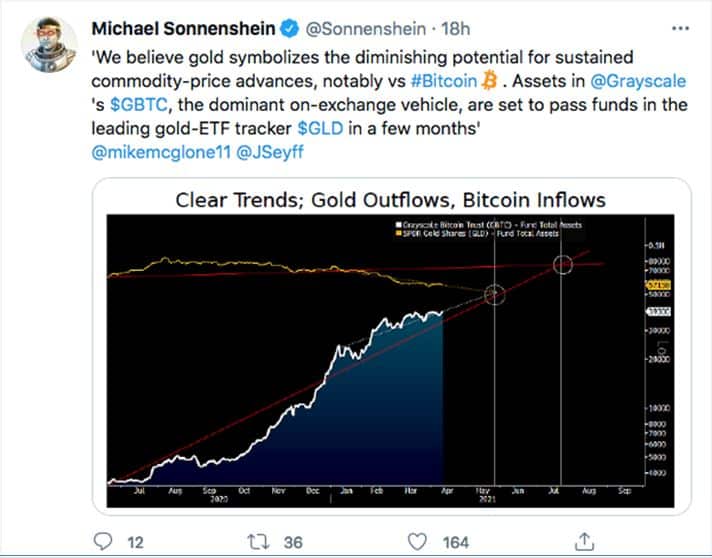
    Asset management firm, Grayscale, has exceeded $50 billion in cryptocurrency holdings for the first time. The asset manager is set to break the record of the largest commodity ETF which stands at a valuation of $57 billion.

    The largest exchange-trade fund GLD, which is physically backed by gold has listing on many major stock markets. GLD is a safe haven investment for investors throughout the world because of its safety and almost zero volatility. But the rise of cryptocurrencies has led to the consideration of cryptocurrencies replacing gold. GLD has nearly stagnant yields and by the principle of the stock market, the high risk of cryptocurrencies is equal to high rewards.

    Grayscale has plans to convert into ETF if the SEC regulations allow. Grayscale would have been the second largest ETF, if approved, currently and close to become the largest. The CEO of Grayscale Michael Sonnenshein believes Grayscale will top GLD soon.

    The asset manager is holding approximately 3.5% of the total BTC circulating supply – around 660,000 Bitcoin tokens. Grayscale’s assets under management range from Bitcoin to lesser known coins. It also has a hefty holding of $7.4 billion ETH in its Ethereum trust funds. The firm has a total of ten crypto trust funds with a total valuation of $50 billion.

  • Exodus Wallet Regulated Offering Record Share Sale

    Exodus Wallet Regulated Offering Record Share Sale

    Exodus a multi-currency wallet that supports over a hundred cryptocurrencies set a record share sale in a regulated public offering. The Delaware-based firm, Exodus Movement, commenced the share sale on April 8 after the approval of the United States Securities and Exchange Commission.

    In just five days, the firm has been able to raise around $59 million. The share is being offered at $27.42 and the offering will last until the goal of $75 million is reached. The crypto wallet had been able to complete around 80% of its fundraising goal from over 4,000 investors.

    The Regulation A sale enabled Exodus to reach far beyond accredited investors. The firm reported a majority of the investment has come from retail and non-accredited investors while accredited investors only accounted for 8% of the total investment. The offering was only available to investors in Texas, Arizona and Florida. The wallet accepted investment in Bitcoin, Ethereum and USDC instead of fiat currency.

    With Coinbase’s NASDAQ listing scheduled for later today, it is expected to shatter Exodus Wallet’s share sale record. Coinbase’s direct listing is expected to be the largest crypto offering in history but with the reference price set below expectations, things may not go as hoped.

  • Coinbase’s reference price of $250 lower than expectations

    Coinbase’s reference price of $250 lower than expectations

    The leading cryptocurrency exchange Coinbase is all set to be listed on NASDAQ. The cryptocurrency world is holding its breath for Coinbase’s direct listing. Coinbase is the first significant direct listing on NASDAQ.

    Coinbase’s ticker COIN received a reference price of just $250 which is much lower than the expectation. However, the direct listing means the reference price is not an indicator of Coinbase’s market capitalization. The reference price of $250 signifies a valuation of $65 billion whereas estimates range anywhere from $68 billion to $120 billion.

    The NASDAQ announcement was quick to point out that the reference price does not indicate the offering price and that no trade has taken place at the price of $250. The reference price had been decided with the consultation of Coinbase and while keeping its transaction history. The opening price will be determined by the sell and buy orders in the auction.

    Coinbase has also surprised its full-time employees with 100 shares each. The current reference price makes it $25,000 per employee of the 1,700 workforce of Coinbase. This was a “thank you” gesture from Coinbase and employees can sell their shares immediately after Coinbase goes public.

    The Coinbase NASDAQ listing is one of the most anticipated events and other major crypto exchanges are set to follow if the listing and opening price surpass expectations. Kraken, a Coinbase competitor, has already hinted towards their stock exchange listing as well which may happen in 2022.

  • US Postal Service In On The NFT Frenzy

    US Postal Service In On The NFT Frenzy

    The United States Postal Service has announced its entry into the NFT sphere but not to sell artwork but rather to help customers purchase postage. CaseMail, a communication platform, has been certified by the US Postal Services to be the first block chain generated epostage. CaseMail’s NFT postage are now eligible for use in the United States. The tokens will be digitally stamped by USPS’ epostage.

    CaseMail CEO and Founder, Joe Ruiz, stated this hallmark moment may help “demystify” the non-fungible tokens’ technology for the masses – which may help accelerate the acceptance of NFTs and cryptocurrencies, in general. The United States Postal Service reported revenues worth $73.1 billion – indicating the availability of NFT to a massive userbase.

    CaseMail has decided to offer the postage tokens to legal professionals and government agencies. In the second quarter, plans are set to enable the use of the tokens for the larger public as well through partnerships with service providers to consumers and businesses. The whole market is set to be captured. CaseMail is just one example of the block chain technology’s real-world use. Because of the bull run, increasingly more attention is being paid to the cryptocurrency world and its technology with many firms getting into the market to discover and explore real-world uses of the technology for different industries.

  • Rampant Complaints About Signal’s MobileCoin Integration

    Rampant Complaints About Signal’s MobileCoin Integration

    The end-to-end encrypted messenger app Signal had been gaining popularity since the acquisition of WhatsApp by Facebook. Signal had been vocal about protecting the privacy rights of users which is why the messenger application is designed so. However, Signal designed to take its mission a step further by incorporating a privacy coin into its application for fast and anonymous transactions.

    Signal and MobileCoin’s partnership has had a rocky journey and the beta version of the application has not even been launched throughout the world. Users started speculating about the connection that the CEO of signal has with MobileCoin and the possible motives behind the partnership as MobileCoin started soaring days before the announcement.

    The messenger app had run a test pilot in the UK and has released the report of the test run. The report also revealed the top four complaints of users. The top complain was the transaction fee of $0.60 is too high – understandably. Followed by the intricacies of actually transferring funds. The UK users had to resort wiring transfer money to exchanges which support MobileCoin. The process is complex and also incurs additional fees. Finally, cryptocurrencies are known for their brutal volatility and the firm acknowledged that the price volatility of MobileCoin will pose a problem for users.

    However, Signal has taken notes of all the major complaints and is actively working on resolving as much as it can.

  • South Korea’s Largest Bank Joins Hedera Network

    South Korea’s Largest Bank Joins Hedera Network

    Shinhan Bank – the largest bank in South Korea in terms of total assets – has joined the governance council of Hedera. The bank official has joined the Hedera network in order to further financial innovation through Hedera’s distributed ledger which the bank stated to meet the needs of the FinTech sphere perfectly – with its security and efficiency.

    The decentralized public network will act as infrastructure for the leading bank to improve their internal processes and bring further innovations into the banking sector. DLTs have been increasing being used in the FinTech sphere and South Korea’s largest bank plans on harnessing the potential of DLTs for banking services.

    Shinhan Bank has been an active advocate of distributed ledger technology for the use of financial innovation. The bank had invested in Korea Digital Asset Custody and had also completed a demonstration platform for central bank digital currencies (CBDCs). Joining the governance of Hedera Network is just the next step in the bank’s mission to innovate and revolutionize the finance industry.

    The CEO of HederaHashgraph, Mance Harmon, had stated there had been a spike in the use of DLT in the finance sphere because of its suitability for the industry. IBM had also announced a Tech Preview with HederaHashgraph which demonstrated the juncture of IBM and Hedera’s technology for permissioned transaction processing.

  • Cryptocurrencies Moving Into Miami Nightlife

    Cryptocurrencies Moving Into Miami Nightlife

    E11EVEN, a high-end Miami nightclub, has announced the acceptance of Bitcoin and other cryptocurrencies as a payment mode. E11EVEN will become the first corporate club to dip their toes into the cryptocurrency world. Other nightclubs can be expected to follow the footsteps of E11EVEN and create a ripple effect.

    The operating partner Gino Lopinto stated that the club has exclusive clientele from all over the world – most of whom are already into the cryptocurrency sphere. The club disregarded the press release as just that but rather expects payments to be made in Bitcoin, Ethereum, Dogecoin, and other cryptocurrencies soon.

    E11EVEN had been closed due to the pandemic since 2020. However, as things start to move back to normal, the club is scheduled to reopen on April 23 with a bang. The nightclub has declined to comment on which cryptocurrency payment processor will it be utilizing.

    The bull run of 2021 has escalated cryptocurrency adoption throughout the world. From real estate firms accepting Bitcoin to major banks in the US making their debut into the cryptocurrency sphere, cryptocurrencies can be seen everywhere. The block chain technology has the potential to bridge many gaps that exists in processes throughout industries while cryptocurrencies provide a more efficient payment method. The adoption of cryptocurrencies can only be expected to increase in the coming days.

  • Bitcoin in Ethereum: Keep Network’s Second Version of tBTC

    Bitcoin in Ethereum: Keep Network’s Second Version of tBTC

    KEEP Network aim is to utilize computers on the global scale for storage of private information with the block chain and smart contract technology. The Network has been working on bringing Bitcoin to the Ethereum platform. For this purpose, a tokenized and trust-minimized version of Bitcoin – tBTC – has been under works.

    tBTC was launched on the main net in September and it has been a rollercoaster ride for Keep Network ever since. tBTC’s version one had some drawbacks because of which it struggled to scale. tBTC had required KEEP and ETH as collateral and the unavailability of ETH in the network proved to be a major constraint.

    EvandroSaturnino, a Keep Network developer, detailed major changes that are to be incorporated into the second version of tBTC in order to tackle the issues the first version had been facing. Per the developer, tBTC v2 will only require KEEP tokens to be kept as collateral. Moreover, a safer and more efficient wallet generation system is also under works which will generate a new wallet every week.

    Many entities have had numerous tries to bring Bitcoin to the Ethereum network – Bitcoin with its position in market and Ethereum being the pioneer of DeFi. However, none had been successful in completing the process in a completely decentralized way. Keep Network’s tBTC will enable BTC to be truly permission-less on the Ethereum network. The success of the project can result in to propel the value of both BTC and ETH.

  • Binance Smart Chain Under Fire For Centralization

    Binance Smart Chain Under Fire For Centralization

    Binance Smart Chain (BSC)  utilizes a Proof of Staked Authority consensus mechanism. Per the mechanism, the network has 21 active validators which are hand-picked daily by the 11 validators of Binance Chain.

    A researcher from the crypto research firm Messari has pointed out towards the lack of decentralization in the staking mechanism of BNB. The researcher, Ryan Watkins, vocalized his disdain for the Binance community for leading inexperience investors awry with narratives of decentralization. Watkins further bashed the network, stating the speed of BSC is not because of any technological innovation but rather due to its centralization. Watkins further called BSC a centralized Ethereum fork.

    Binance Chain was launched by Binance to ensure speed to trading but smart contracts on the network ended up slowing it down drastically. As a result, Binance Smart Chain was launched to facilitate the use of smart contracts and Ethereum Virtual Machine (EVM). BSC runs parallel to Binance Chain and is an independent block chain. It is also the staking mechanism for Binance Coin (BNB).

    The Binance Community was quick to rush to the rescue of BSC. Some stating the phenomenal performance of BNB in the first quarter of 2021 to be enough reason for the validity of the technology. While other users regarded copying as inherent to technological innovation.